
CCNA Practice Exam 2
A second set of twenty CCNA practice questions, new and written for this course, under the same rules: one best answer, no notes the first time, an optional 35-minute clock. Before a troubleshooting question, sort what you know into three trays: what you heard, what you observed in output, and what you tested on purpose.
By Arif, founder of Daveth · Updated
The full 6 min walkthrough is in Daveth Pro (Network). See what the plan opens
What this page answers
How do you approach CCNA troubleshooting questions?
Sort what you know into three trays: heard, what someone told you; observed, output you read yourself, which proves only what that command shows; and tested, something you did on purpose with a result you predicted first. Read it in “Heard, observed, tested”
Before you start
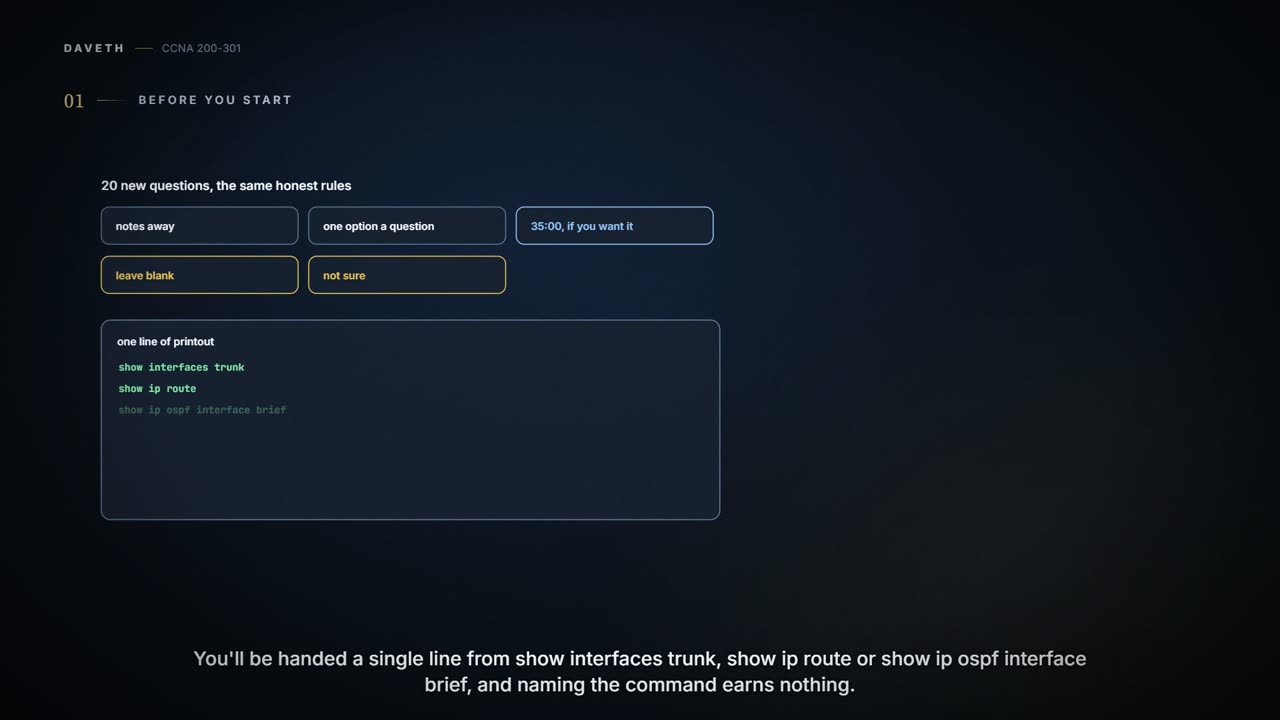
Same rules as the first practice exam: one best answer each, no notes the first time, a 35-minute clock if you want it, and "leave blank" or "not sure" whenever that's the honest answer. The questions are new. They were written for this course, and they don't copy the exam's or anyone else's. Nothing about the answers appears until you submit, and then your answers lock.
This set leans on output. Several questions hand you a line from show interfaces trunk, show ip route or show ip ospf interface brief, and the point isn't the command's name. It's what that line proves, and what it doesn't.
The terminal has no feelings. It will tell you the bad news clearly if you ask the right question.
Heard, observed, tested
Before a troubleshooting question, sort what you know into three trays. Heard is what someone told you: "the wireless is down", "I already checked the trunk". Observed is output you read yourself; it proves what that command shows, and nothing past it. Tested is something you did on purpose, with a result you predicted first, such as a ping whose result you called before you pressed Enter.
You can think of it as a service desk with three trays, where a note moves to the next tray only when someone does the work to move it. (Where it stops: on a desk a note can sit in any tray for ever; in troubleshooting, a heard claim that never moves shouldn't decide a repair.)
And predict before you read. Say what you expect the output to show, then read it. A match confirms your picture of the network. A surprise is more useful: it shows where the picture is wrong. Typing a show command without a prediction only gets you text.
The exam
20 questions, 35 minutes if you want the clock
- Network Fundamentals Are the server 203.0.113.20/26 and its gateway 203.0.113.1 in the same subnet? a. No: .20 and .1 fall in different /26 blocks b. Yes: 203.0.113.0/26 runs from .0 to .63 c. No: .1 is the subnet ID, so it can't be a gateway d. Only if the mask on the gateway is /24 leave blank not sure
- Network Fundamentals Which medium normally reaches the longest distance at a given Ethernet speed? a. Category 6 UTP copper b. Multimode fibre c. Shielded twisted pair d. Single-mode fibre leave blank not sure
- Network Fundamentals What lets a TCP sender notice and resend missing segments? a. Sequence numbers and acknowledgments b. The three-way handshake alone c. The TCP window size d. The TCP checksum leave blank not sure
- Network Fundamentals What does a container usually share with its host? a. Its application libraries and binaries b. A hypervisor that emulates its hardware c. The host's operating system kernel d. A full guest operating system leave blank not sure
- Network Access show vlan brief lists VLAN 30, but show interfaces trunk says the allowed VLANs are 10 and 20. A remote VLAN 30 host can't be reached. What's the first repair? a. Create VLAN 30 again on this switch b. Change the trunk's native VLAN to 30 c. Add VLAN 30 to the trunk's allowed list d. Move the host's port to VLAN 10
- Network Access A switch's CDP table shows one neighbour, but the device from another maker on the next port never appears. What would let both find each other? a. LLDP, enabled on both b. CDP version 2 c. UDLD d. A longer CDP holdtime leave blank not sure
- Network Access Someone plugs a small switch into a PortFast port that has BPDU Guard, and a BPDU arrives. What happens, by default? a. The port moves straight to forwarding b. The port drops PortFast and runs normal STP c. The port blocks until the BPDUs stop d. The port goes err-disabled leave blank not sure
- Network Access A client associates with an SSID, but the WLAN is mapped to the wrong VLAN. What's the likely result? a. Association fails, so the SSID can't be joined b. The client gets an address from the wrong subnet, or none c. The client gets the right address but no DNS server d. The client works, since the VLAN only matters for wired hosts leave blank not sure
- IP Connectivity show ip route on R1 lists "S* 0.0.0.0/0 [1/0] via 203.0.113.1" and "C 192.0.2.0/24 is directly connected, GigabitEthernet0/1". Where does R1 send a packet for 192.0.2.9? a. Out GigabitEthernet0/1, on the connected /24 b. To 203.0.113.1, on the default route c. Both ways, load balanced d. To 203.0.113.1, since static routes beat connected ones leave blank not sure
- IP Connectivity R1 learns 10.9.0.0/16 from OSPF as [110/20], and also has a static route to it, [1/0]. Which does R1 install? a. The OSPF route, since [110/20] carries a real metric b. The static route, at distance 1 c. Both, sharing the load between them d. Whichever of the two was learned first leave blank not sure
- IP Connectivity R1's OSPF neighbour on the transit link has gone. show ip ospf interface brief shows R1's Gi0/1 with PID 1, area 0, cost 1, and R2's Gi0/1 with PID 2, area 1, cost 10. What's the best explanation? a. The router IDs clash b. The process IDs differ, 1 and 2 c. The interface costs differ, 1 and 10 d. The areas differ, so no adjacency forms leave blank not sure
- IP Connectivity R1 can ping R2's transit address but not a host on R2's LAN. What do you check before blaming the transit link? a. The transit link's cable and duplex settings on both ends b. R1's ARP entry for R2's transit address, and R2's ARP entry for R1's c. The route to that LAN, the route back, and the LAN interface's state d. The MTU on the transit link leave blank not sure
- IP Connectivity Which command shows the IPv6 routes a router has installed? a. show ip route b. show ipv6 interface brief c. show ipv6 neighbors d. show ipv6 route leave blank not sure
- IP Services Where does ip helper-address go, for clients whose DHCP server is on another subnet? a. On the routed interface facing the clients b. On the interface facing the DHCP server c. On the DHCP server itself d. On every interface of the router leave blank not sure
- IP Services Right after configuring dynamic PAT, before any client traffic, show ip nat translations is empty. What next? a. Remove the configuration, since NAT has clearly failed b. Add a static NAT entry so the table has something in it c. Send matching traffic, then read the table and the configuration d. Clear the translation table and wait for it to refill leave blank not sure
- Security Fundamentals What does a standard IPv4 ACL match on? a. Source and destination addresses b. The source IPv4 address c. Source address and TCP or UDP port d. The destination address only leave blank not sure
- Security Fundamentals Why do DHCP snooping bindings matter to DAI? a. DAI uses them to decide which ports are trusted b. DAI uses them to hand out leases c. DAI checks ARP IP and MAC claims against them d. DAI copies them into the MAC address table leave blank not sure
- Security Fundamentals With WPA2-Personal (PSK), what do clients use to join? a. A per-user password checked by a RADIUS server b. A certificate on each client c. Their own MAC address d. A shared passphrase leave blank not sure
- Automation and Programmability What does PATCH to an API resource generally mean? a. A partial update of the resource b. Replace the whole resource c. Create a new resource d. Read the resource only leave blank not sure
- Automation and Programmability In the JSON object {"ports": ["Gi0/1", "Gi0/2"]}, what is the value of ports? a. An object with two keys b. An array of two strings c. A list of two keys, Gi0/1 and Gi0/2 d. Two separate key/value pairs leave blank not sure
Continue the lesson
The whole lesson, with its drawings and its questions. The rest of this section and 2 more after it.