
SNMP v2c and v3
"We are on version 3, so monitoring is secure" is not necessarily true. SNMP has a manager, an agent and a MIB, and three versions. Version 3 has three levels, and only authPriv encrypts. The level is set on the group and the passwords on the user line, and both are needed. An snmp-server command with no version keyword defaults to version 1, and no level keyword to noAuthNoPriv.
By Arif, founder of Daveth · Updated
The full 8 min walkthrough is in Daveth Pro (Network). See what the plan opens
What this page answers
Is SNMPv3 always encrypted?
No. SNMPv3 has three security levels, noAuthNoPriv, authNoPriv and authPriv, and only authPriv encrypts. The level is chosen on the snmp-server group. Read it in “The matrix”
What is the default SNMP version on Cisco IOS XE?
If no version keyword is present, the default is version 1, and if no security level keyword is entered, the default is noauth, noAuthNoPriv. Read it in “The default nobody expects”
How do you configure SNMPv3 authPriv?
Set the level on the group, snmp-server group name v3 priv, and the authentication and privacy passwords on the user, snmp-server user name group v3 auth ... priv ...: both are needed. Read it in “Asking for the bottom row”
We are on version 3, so monitoring is secure
That sentence turns up in audit reports, design documents and handover notes, and it is not necessarily true. This page is mostly about one table.
The three parts, and three versions
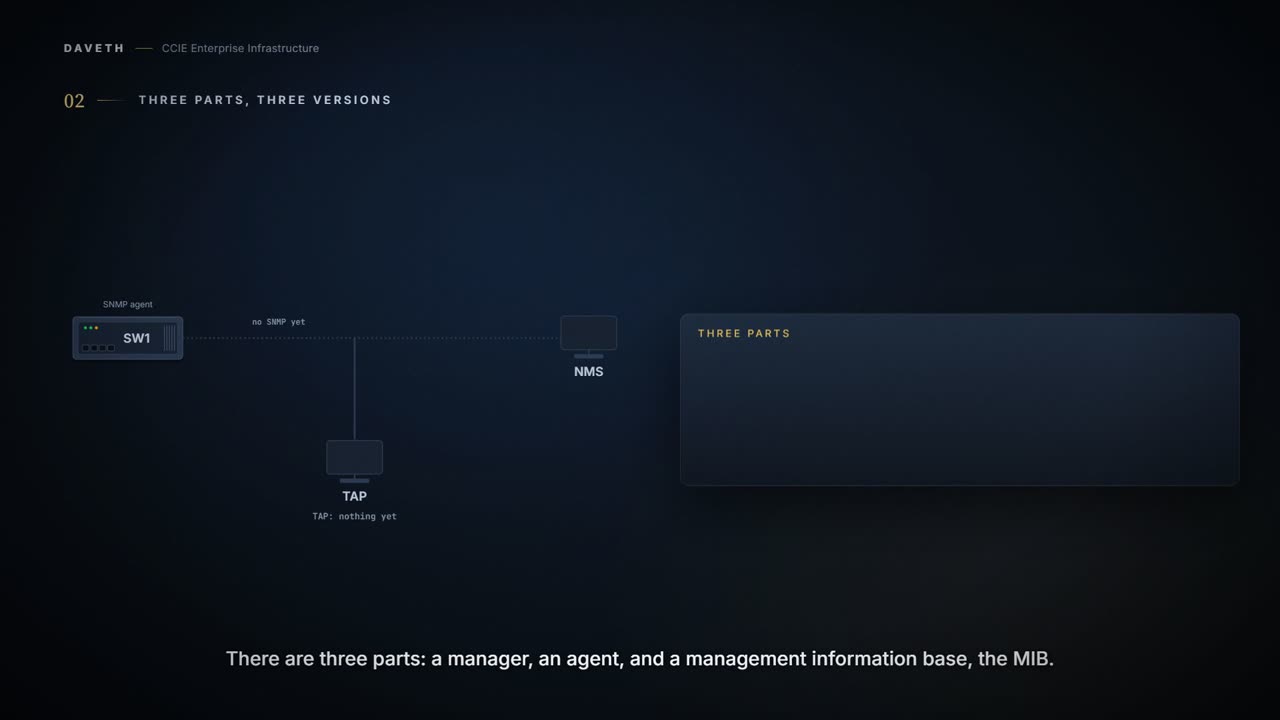
SNMP is an application-layer protocol that provides a message format for communication between managers and agents. The SNMP system consists of an SNMP manager, an SNMP agent, and a management information base (MIB).
Manager polls. Agent answers. The MIB is the structure of what can be asked. Now read what each version actually claimed:
SNMPv1—The Simple Network Management Protocol, a Full Internet Standard, defined in RFC 1157. SNMPv2C—The community-string-based Administrative Framework for SNMPv2, an Experimental Internet Protocol defined in RFC 1901. replaces the Party-based Administrative and Security Framework of SNMPv2Classic with the community-string-based Administrative Framework of SNMPv2C while retaining the bulk retrieval and improved error handling of SNMPv2Classic.
Notice what v2C kept: bulk retrieval and better errors, on top of community strings. The security model did not change.
SNMPv3 provides secure access to devices by authenticating and encrypting packets over the network and includes these security features: Message integrity—Ensures that a packet was not tampered with in transit. Authentication—Determines that the message is from a valid source. Encryption—Mixes the contents of a package to prevent it from being read by an unauthorized source.
The matrix
Before you read it, guess how many of the five rows encrypt anything. Step 2 of the walk asks the sharpest case.
The page's security models and levels table. The authentication and encryption cells are abbreviated (the page spells out Message Digest 5, Secure Hash Algorithm, Data Encryption Standard and Advanced Encryption Standard), and the last result is cut at its list, which names DES 56-bit, 3DES 168-bit and AES 128, 192 or 256.
| Model | Level | Authentication | Encryption | Result |
|---|---|---|---|---|
| SNMPv1 | noAuthNoPriv | Community string | No | Uses a community string match for authentication. |
| SNMPv2C | noAuthNoPriv | Community string | No | Uses a community string match for authentication. |
| SNMPv3 | noAuthNoPriv | Username | No | Uses a username match for authentication. |
| SNMPv3 | authNoPriv | MD5 or SHA | No | Provides authentication based on the HMAC-MD5 or HMAC-SHA algorithms. |
| SNMPv3 | authPriv | MD5 or SHA | DES or AES | Provides authentication based on the HMAC-MD5 or HMAC-SHA algorithms. Allows specifying the User-based Security Model (USM) with these encryption algorithms: |
Read down the Encryption column. Four of the five rows say No, and two of those four are SNMPv3. SNMPv3 at noAuthNoPriv authenticates by username match; at authNoPriv it adds HMAC authentication. Neither encrypts anything. A device configured that way is legitimately running SNMPv3 and is no better protected than v2c. Only the bottom row is what people mean when they say v3. Steps 1 to 4 of the walk.
And a healthy graph is no evidence either way. It proves the values arrived. It says nothing at all about how they travelled.
This course's reading of the Encryption column: where it says No, a capture on the management network shows the MIB data readable. The page does not say "clear text" in so many words; the column carries the point.
Asking for the bottom row
The level is chosen on the group, and the passwords go on the user line. Both, or you do not get the row.
The page's syntax, as printed.
snmp-server group group-name { v1 | v2c | v3 { auth | noauth | priv} } [ read readview] [ write writeview] [ notify notifyview] [ access access-list]snmp-server user username group-name { remote host [ udp-port port] } { v1 [ access access-list] | v2c [ access access-list] | v3 [ encrypted] [ access access-list] [ auth { md5 | sha} auth-password] } [ priv { des | 3des | aes { 128 | 192 | 256} } priv-password]priv —Enables Data Encryption Standard (DES) packet encryption (also called privacy).
This course's lines, in that syntax; the passwords are placeholders.
SW1# configure terminal
SW1(config)# snmp-server group MONITOR v3 priv
SW1(config)# snmp-server user nms MONITOR v3 auth sha AUTH-PASSWORD priv aes 128 PRIV-PASSWORD
SW1(config)# end
Look at the user line. The keyword priv on the group is one word; the passwords on the user line are the rest of it. Step 4.
And on a 9300 stack the guide sets an order: the engine ID before any SNMPv3 user.
To avoid SNMPv3 authentication failure, you should manually configure SNMP engineID on the device before SNMPv3 user configuration.
The default nobody expects
Predict this before reading. On a current switch, you type an snmp-server command without a version. What do you get?
If no version keyword is present, the default is Version 1. If no keyword is entered, the default is the noauth (noAuthNoPriv) security level.
Version 1, and noAuthNoPriv one layer down. That is backward compatibility, the right default for a protocol that has to talk to everything. It is also silent: an omitted keyword gives the weakest option in the table, not a modern baseline. The good news in the same defaults table: the SNMP agent is disabled, no trap receiver is configured, and no traps are enabled except the one for TCP connections.
And read-only is the other word that buys less than it sounds like. It stops anyone writing through that access, which is worth having. It does nothing whatever about the reads: every value the manager collects still crosses the network exactly as the level allows, so a community string marked read-only on an unencrypted level is a steady, permitted, readable export of your device's state.
Continue the lesson
The whole lesson, with its drawings and its questions. 5 more sections after the ones above.