
Endpoint security
Antivirus that checks once cannot keep up: attackers build new variants as soon as one stops working, so point-in-time tools fall behind. Cisco's answer draws its verdicts from Talos threat intelligence and Threat Grid, judges files with AMP and keeps checking them, adds AnyConnect and Umbrella on the endpoint, and filters web and email at WSA and ESA gateways.
By Arif, founder of Daveth · Updated
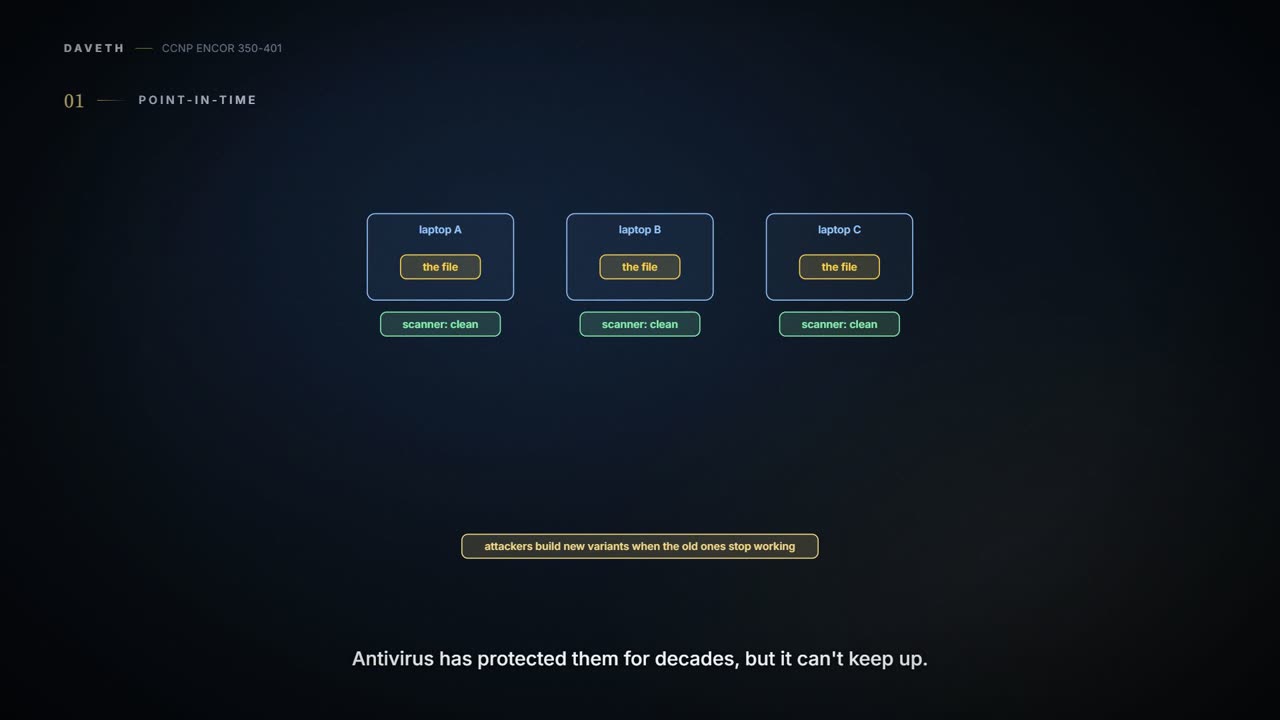
The full 11 min walkthrough is in Daveth Pro (Network). See what the plan opens
What this page answers
Why is antivirus not enough?
Because it is point-in-time: it checks once against known threats, and attackers create new variants as fast as old ones are caught, at a pace static tools cannot cope with. Read it in “4.1 Why "scan it once" stopped being enough”
What is Cisco Talos?
Cisco's threat intelligence organisation, tracking threats across endpoints, networks, cloud, web and email; in 2020 it took in nearly 17 billion web requests, 300 million emails and 1.5 million unique malware samples a day. Read it in “4.1 Why "scan it once" stopped being enough”
4.1 Why "scan it once" stopped being enough
Endpoints are everywhere: phones, laptops, tablets, IP phones, PCs and IoT devices, and with bring-your-own-device policies any of them can join the corporate network. Antivirus has protected them "for decades", but "they can’t keep up with the rapidly evolving threat landscape": attackers build malware that evades detection, and "When the effectiveness of a specific type of malware declines, attackers create new variants". It's basically like a bouncer with a list of banned faces: excellent at stopping anyone on the list, useless against someone new, and no better at the door the next day unless somebody updates the list.
The guide's name for the weakness is "point-in-time": static tools checking once can't cope with threats that change "at a pace that static point-in-time (for example, antivirus) tools can’t cope with". Think about the last time you bought a used car with a year-old MOT certificate: it proves the brakes were fine on the day of the test, not today. What's missing is somebody who keeps a list of every car that passed, and calls them back when a fault turns up. That gap is what the rest of this lesson fills, and 08-5's framework, SAFE, is the map the guide puts these products on.
Antivirus that only knows yesterday's malware is a newspaper: accurate, well organised, and already out of date.
"Talos is the Cisco threat intelligence organization", created from three research teams: IronPort's SecApps, Sourcefire's Vulnerability Research Team and Cisco's TRAC team. It tracks threats across "endpoints, networks, cloud environments, the web, and email", and in 2020 the guide put its daily intake at "nearly 17 billion web requests, 300 million emails, and 1.5 million unique malware samples". Its feeds include Microsoft and industry disclosures, the AMP community, ClamAV, Snort and other user communities, honeypots, private and public feeds and dynamic analysis, and all of it becomes intelligence "fed into a wide range of security products"; in this lesson you'll meet it behind AMP, Umbrella, the WSA and the ESA. You can think of it as a weather service: nobody in town owns a satellite, but every forecast on every channel comes from it. Cisco's Talos page today calls it "a proven and trusted threat intelligence research team" and gives no current volumes, so the guide's numbers are 2020's.
Threat Grid, "acquired by Cisco in 2014", analyses files two ways: static analysis ("checking filenames, MD5 checksums, file types") and dynamic analysis, "also known as behavioral analysis", running the file "in a controlled and monitored sandbox environment" to see what it does. Picture yourself in a situation where a king's food taster eats first: the food is judged by what it does, not by how it looks. There's a catch the guide names: malware often checks whether it's in a sandbox and, if it is, "it won’t run, rendering the analysis useless"; Threat Grid "evades being detected by malware by not having the typical instrumentation". Suspicious files can also be opened by hand in a sandbox called Glovebox; Threat Grid runs as an appliance or in the cloud, and integrated products submit files automatically. Today it's "Cisco Secure Malware Analytics (formerly Threat Grid)".
Malware that won't run in a sandbox is the only software that behaves better when it thinks it's being watched.
Cisco AMP, "formerly FireAMP", is built for what comes after the first check: attackers "have the resources, persistence, time, and expertise to compromise any network relying solely on point-in-time detection mechanisms", and "Point-in-time detection is completely blind to the scope and depth of a breach after it happens". So AMP covers the whole continuum: before, intelligence from Talos and Threat Grid; during, file reputation and sandboxing; after, "retrospection, indicators of compromise (IoCs), breach detection, tracking, analysis, and surgical remediation".
The pieces: the AMP Cloud (public or private), connectors, and AMP for Endpoints (Windows, macOS, Android, iOS and Linux), for Networks (NGFW, NGIPS, ISRs), for Email (ESA), for Web (WSA) and for Meraki MX, all fed by Talos and Threat Grid. On iOS the guide's name for it is the Cisco Security Connector, which adds Umbrella. The cloud is the part that matters: it holds each file's reputation, its "file disposition": malware, clean, unknown or custom. And the disposition "can change based on data received from Talos or Threat Grid". Think of it as a file's credit rating: it can be revised as new information arrives, and a downgrade reaches everyone holding it. An unknown file goes to Threat Grid; a file judged malicious is "reported to AMP connectors that see the same file", and the cloud "is capable of identifying malware on files that were previously deemed to be clean".
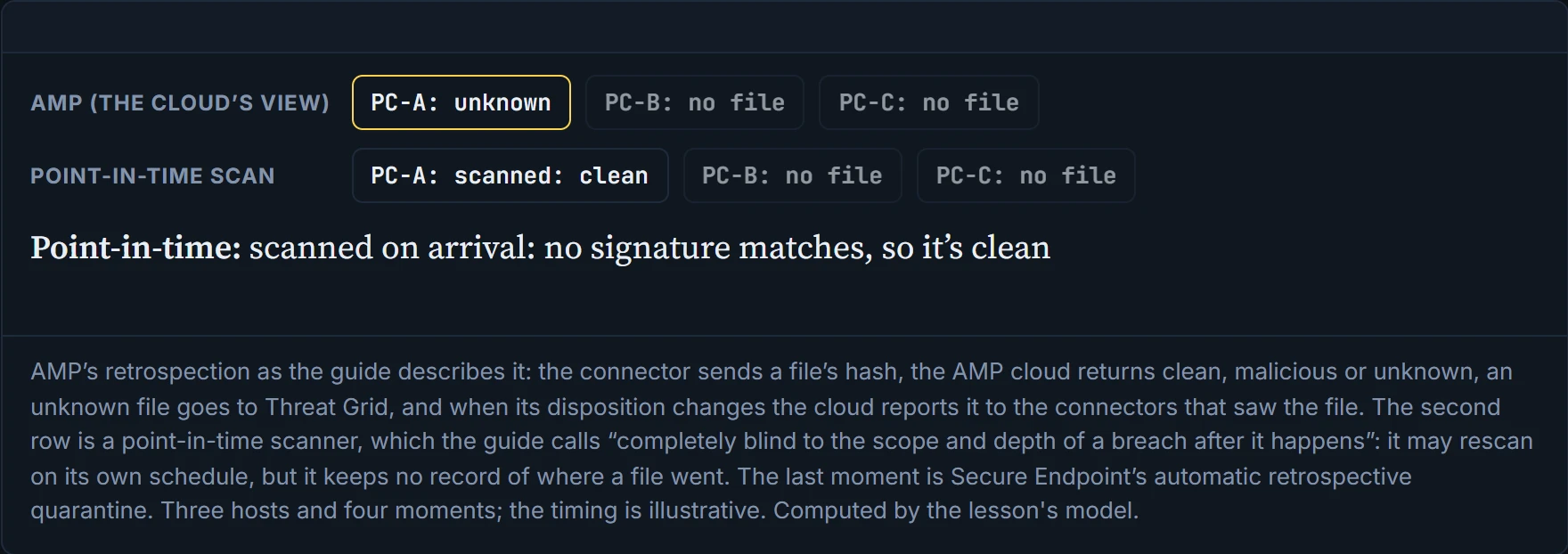
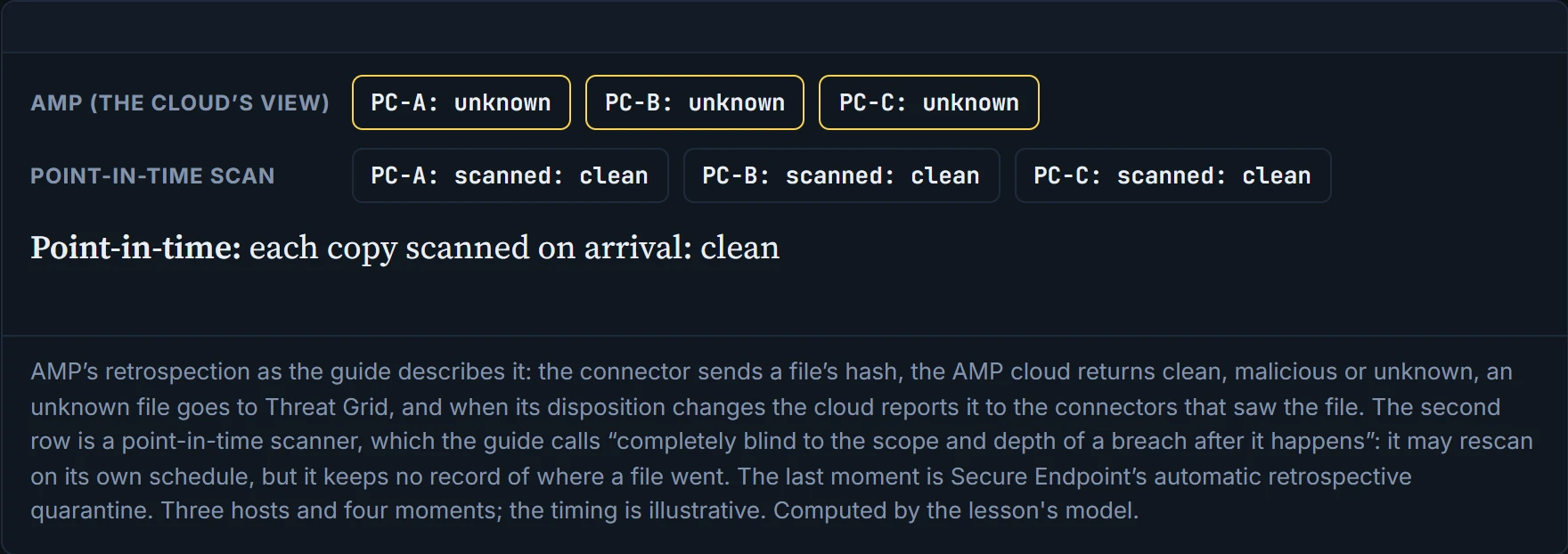
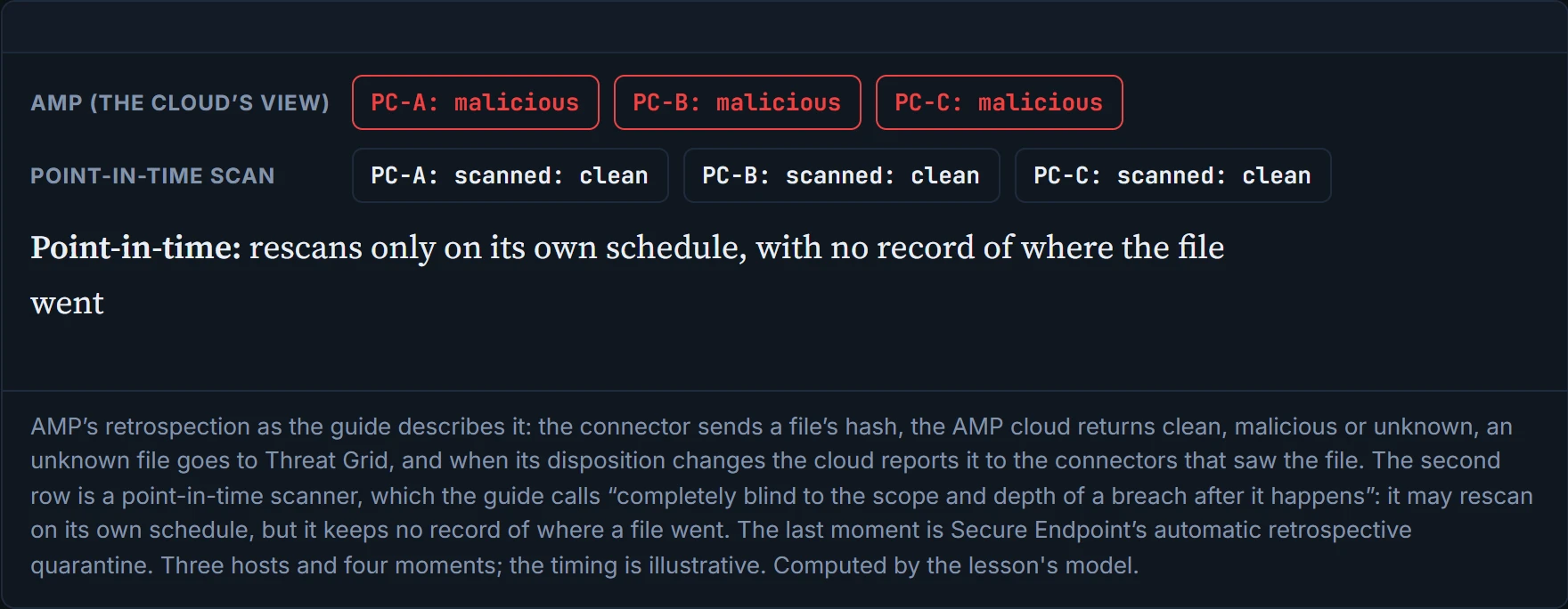
Connectors stay light because they don't carry a signature database: they send "a hash to the cloud" and get back "a verdict ... of clean, malicious, or unknown". A hash is like a fingerprint: it identifies the file without carrying the file. Just like when you get a letter from a shop saying a batch you bought has been recalled: the shop didn't know it was faulty when you bought it, but it kept a record of who bought what, and it tells everyone once it knows. That's retrospection, and Cisco's current wording for it is that Secure Endpoint "correlates new threat information with your past history and automatically blocks and/or quarantines files". It also has more than hashes today: "Machine learning in Secure Endpoint can help scale detections and detect never-before-seen malware at the point of entry", and behavioural analysis stops malicious processes in real time. Work it out from the paragraph above before you look at D1: when the verdict changes, which hosts' copies are dealt with, and what does the point-in-time scanner say about them?
D1
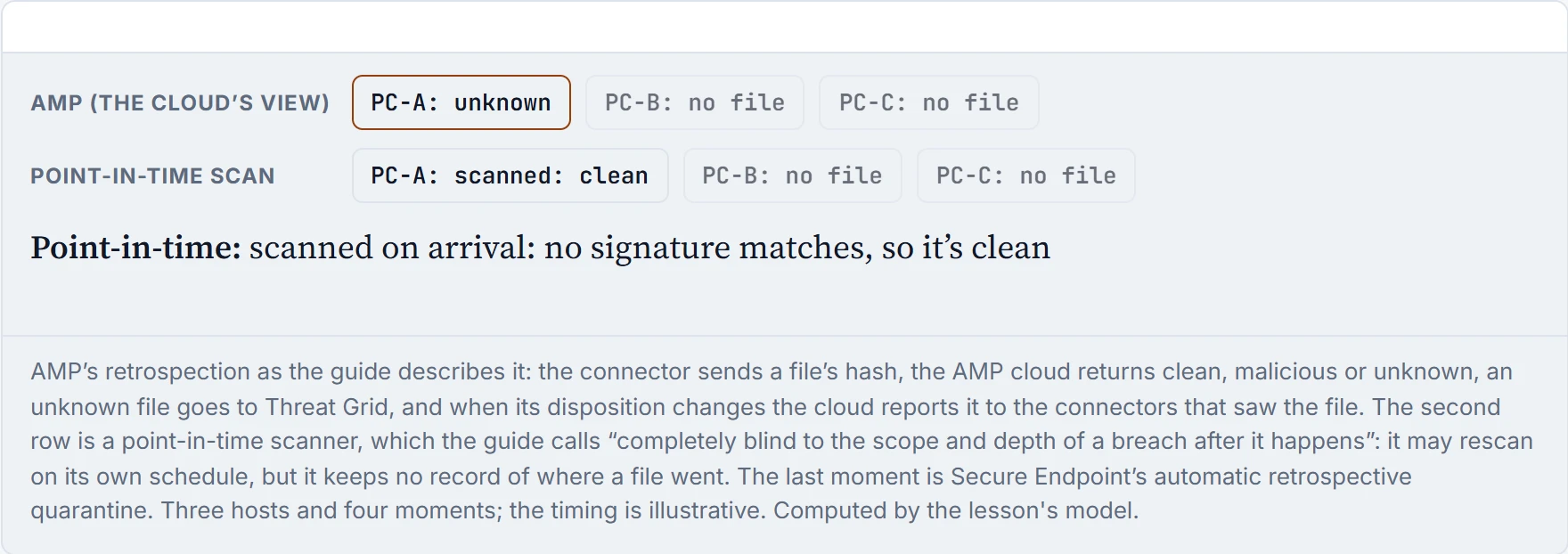
Step 1 of 4 PC-A downloads a file. Its connector sends the hash; the AMP cloud has no verdict (unknown), so the file runs and is sent to Threat Grid.
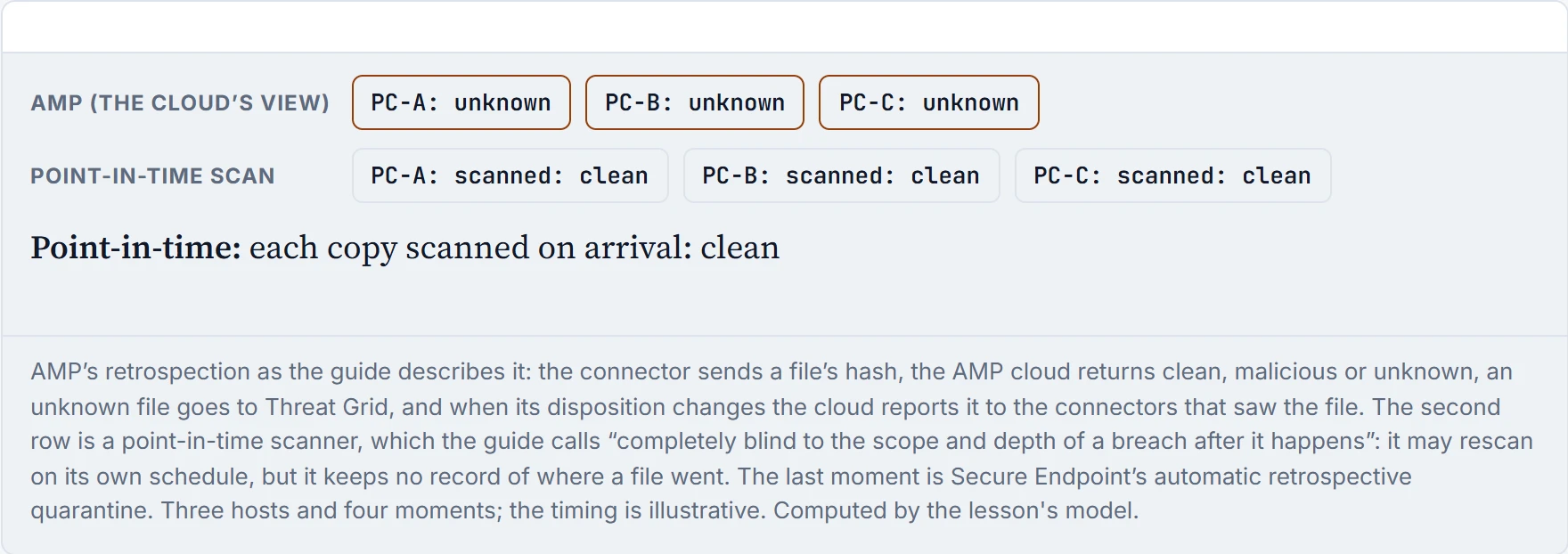
Step 2 of 4 The file is copied to PC-B and PC-C. Each connector reports the same hash, so the cloud has a record of where it went.
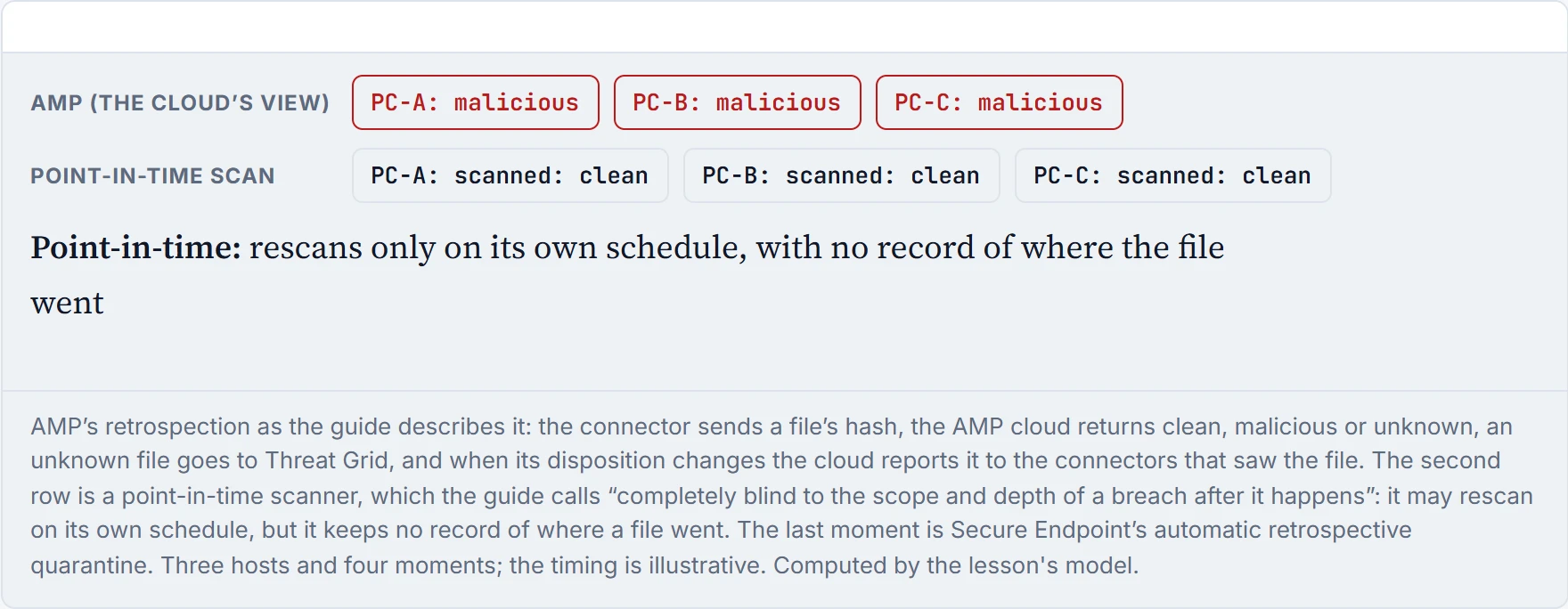
Step 3 of 4 Threat Grid's sandbox finds malicious behaviour. The file's disposition in the AMP cloud changes to malicious; the cloud now knows every copy it recorded is bad.
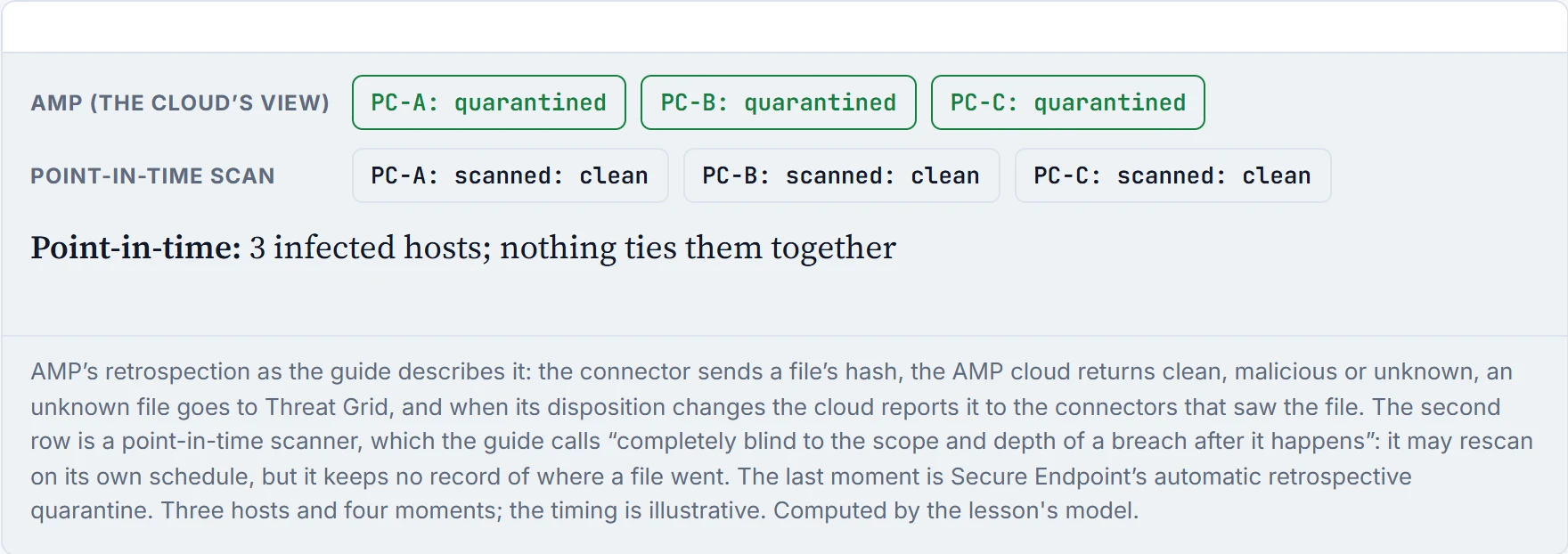
Step 4 of 4 Secure Endpoint correlates the new verdict with its history and quarantines the copies on PC-A, PC-B and PC-C. The point-in-time scanner has three infected hosts and nothing that ties them together.
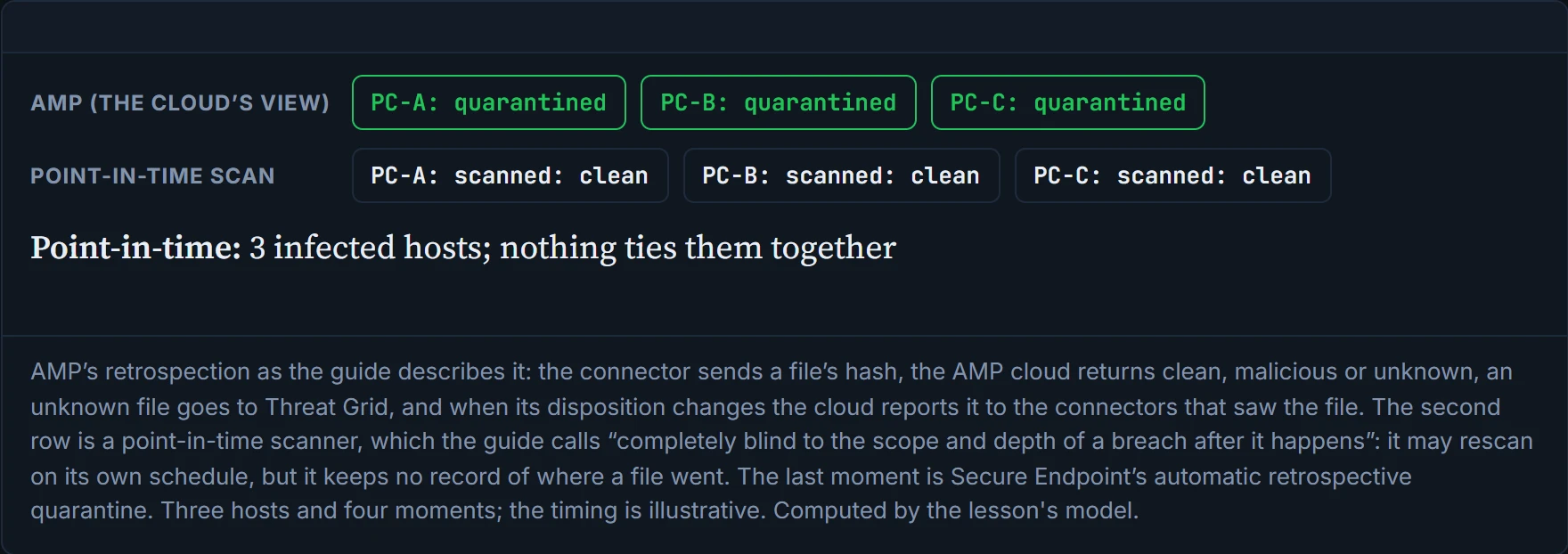
Today AMP for Endpoints is "Cisco Secure Endpoint (Formerly AMP for Endpoints)", described by its "prevention, detection, threat hunting, and response capabilities", and AMP across Cisco's portfolio is "Malware Defense" (08-5).
AMP is the colleague who emails you three weeks later to say "about that file you opened", and is right to.
"The Cisco AnyConnect Secure Mobility Client" is a VPN client, over "Transport Layer Security (TLS)/Secure Sockets Layer (SSL) and IPsec IKEv2", and more: its VPN Posture (HostScan) and ISE Posture modules check an endpoint "for things like antivirus, antispyware, and firewall software", and a non-compliant endpoint's access "can be restricted until the endpoint is in compliance" (ISE's side of that decision: 08-7). It also offers web security, flow visibility into Stealthwatch, and "roaming protection with Cisco Umbrella: even while the AnyConnect client is not connected to the corporate network through a VPN". If you've ever connected a laptop to hotel Wi-Fi, you know why that last part matters: the laptop is outside every gateway the company owns. The guide adds that "TLS/SSL" really means TLS, since "The SSL protocol has been deprecated by the IETF". Today the client is "Cisco Secure Client (including AnyConnect)".
Umbrella, "formerly known as OpenDNS", blocks "requests to malicious Internet destinations (domains, IPs, URLs) using the Domain Name System (DNS) before an IP connection is established or a file is downloaded", and it's "100% cloud delivered". It acts kind of like a phone that blocks known scam numbers before it even rings: the call never connects, so there's nothing to hang up on. Why DNS? Because "DNS is the first step in making a connection on the Internet", and "all internet-connected devices use recursive DNS services". In 2020 the guide gave it 30 data centers on anycast DNS, a guaranteed "100% uptime", and intelligence from "175 billion daily DNS requests from more than 90 million users", fed into a graph database and machine-learning models and supplemented by Talos; Cisco's 2023 page says "30+ unique locations", with the same resolver addresses answering everywhere.
Deploying it is a DHCP change: point the gateways' DHCP configuration at Umbrella so "all devices, including guest devices, forward their DNS traffic" there. Off the network, AnyConnect's roaming module sends DNS to Umbrella "even when the VPN is turned off", or the Umbrella roaming client "tags, encrypts, and forwards DNS queries". The standalone roaming client has since reached end of life ("Software maintenance will end on April 2, 2025"); its replacement is Cisco Secure Client with "the Umbrella Roaming Security Module". On a dual-stack network, IPv6 clients need Umbrella's IPv6 resolvers too, 2620:119:35::35 and 2620:119:53::53. Figure 25-4 shows what the user sees: a block page for the phishing site.
Umbrella's whole pitch is that it blocks the bad site before your browser has finished asking where it is.
The WSA is "an all-in-one web gateway" that uses Talos and Threat Grid intelligence and provides "vital data loss prevention (DLP) capabilities across the full attack continuum". Consider it your building's post room: every parcel coming in is checked against what's known, x-rayed, and logged, and anything leaving can be checked too. Its protections follow the continuum:
| Phase | WSA protection |
|---|---|
| Before | web reputation filters; web filtering (URL database plus the Dynamic Content Analysis engine); Application Visibility and Control |
| During | cloud access security (CASB partners), parallel antivirus scanning, Layer 4 traffic monitoring, file reputation with AMP, file sandboxing (Figure 25-5), DLP through ICAP |
| After | AMP retrospection over "an extended period of time"; Global Threat Analytics (formerly Cognitive Threat Analytics) |
Before an attack, web reputation filters "analyze more than 200 different web traffic and network-related parameters" and give a site a score "from −10 to +10, instead of the binary good or bad", so a site is "blocked, allowed, or delivered with a warning"; unknown URLs are categorised and blocked if they "fall below a defined security threshold". Today's product draws the bands like this by default: "-10 to -6.0" blocked, "-5.9 to 5.9" an "Undetermined site" whose request "is passed to the DVS engine for further malware scanning", and "6.0 to 10.0" allowed; its reputation settings show no warn action. Talos refreshes that reputation data "every three to five minutes". Web filtering checks a database the guide gave as "more than 50 million blocked sites" and uses DCA to categorise "90% of unknown URLs" in real time; AVC controls "more than 150,000 micro-applications", down to blocking the Like button. During an attack, it adds CASB partners, parallel AV engines, a Layer 4 monitor for spyware "phone-home" traffic, file fingerprints checked against the AMP cloud, and DLP through ICAP to third-party systems. After, it keeps rescanning with AMP retrospection, and Global Threat Analytics uses machine learning on web, endpoint and Stealthwatch data; the WSA runs in the cloud, as a virtual appliance, on premises or hybrid. Today it's "Cisco Secure Web Appliance (formerly Web Security Appliance (WSA))".
The ESA does the same for email, "one of the top attack vectors for security breaches". It takes Talos and Threat Grid intelligence, filters by reputation, and catches spam with its Context Adaptive Scanning Engine at "a spam catch rate greater than 99%, with a false-positive rate of less than 1 in 1 million". It detects forged email aimed at executives (business email compromise), models trusted senders with Cisco Advanced Phishing Protection, and uses Cisco Domain Protection to stop phishing sent "using a customer domains". It also scans for malware with AMP for Email, flags graymail and offers Safe Unsubscribe, filters URLs, and runs outbreak filters that "can rewrite URLs included in suspicious email messages" so a click is checked before the page opens; it reports who clicked, and it encrypts or quarantines outbound mail that matches its "more than 100 expert policies". The guide sends that click "to the WSA"; the current guide says it goes "through the Cisco web security proxy. This is an external proxy hosted by Cisco". Outbreak filters can also hold a message back. Have you ever noticed how a good receptionist keeps a doubtful parcel behind the desk until it's been checked? That's roughly equivalent to the outbreak quarantine: "As new rules are downloaded, messages in the Outbreak quarantine are reevaluated", and a message whose threat level falls is released automatically. Today it's "Cisco Secure Email (formerly Cisco Email Security Appliance (ESA))", with the same "greater than 99 percent" catch rate.
Put the four together and follow one attack. Before you use D2: with all four layers on, where is a phishing email linking to a brand-new domain stopped?
D2
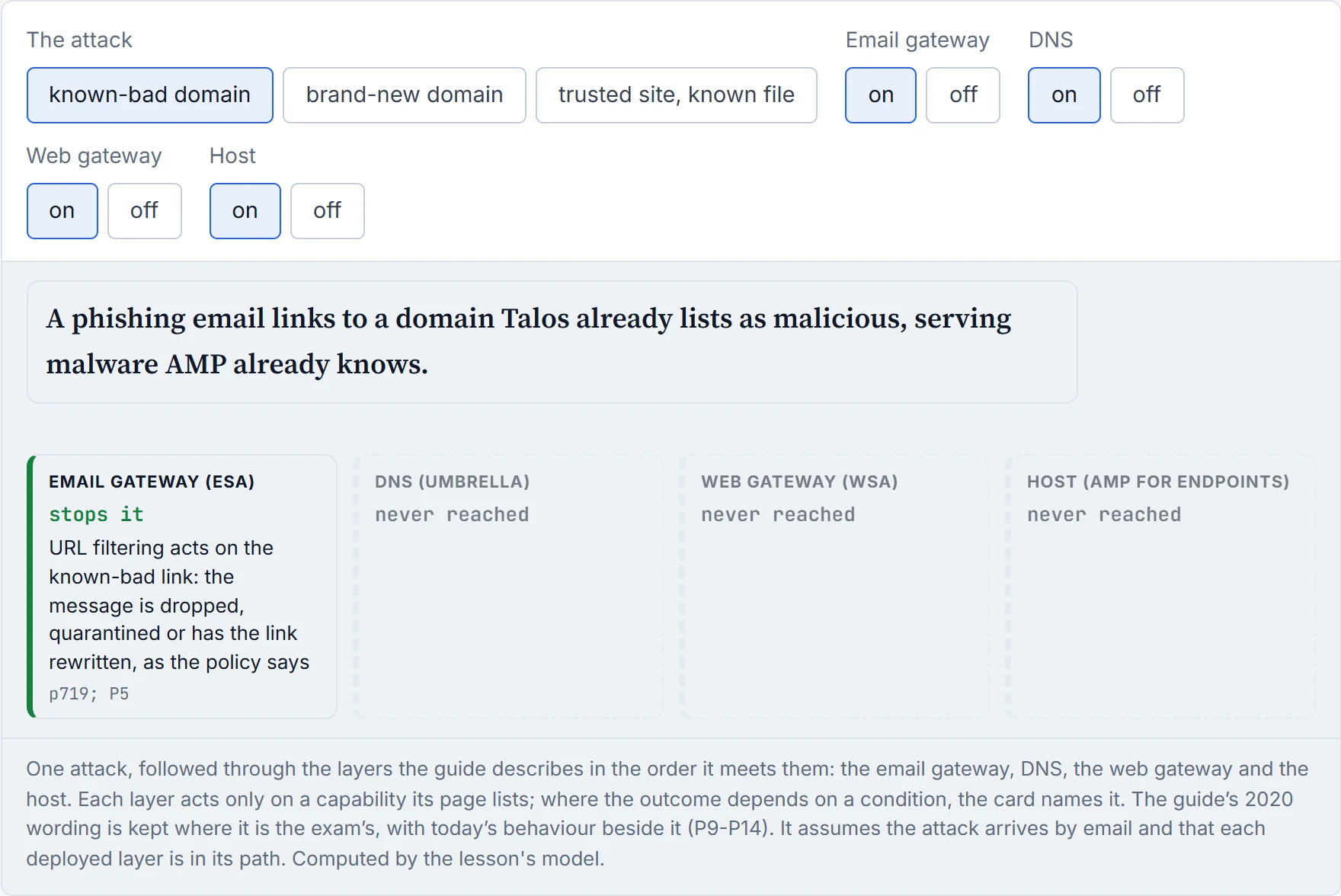
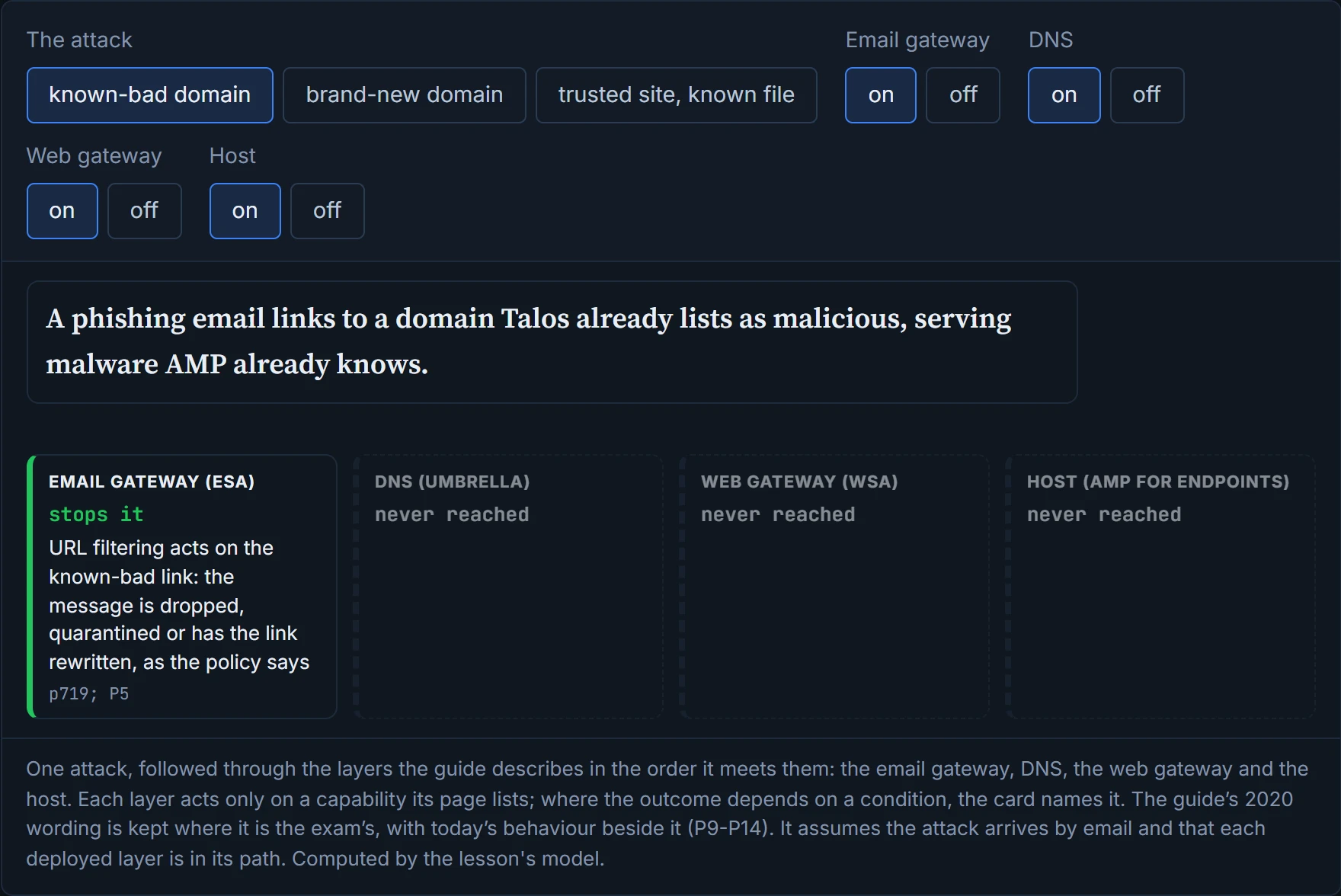
The email may have its link rewritten; the brand-new domain resolves unless the policy blocks newly seen domains; the web gateway scans it because its reputation is undetermined, and may stop it; and if the file still reaches the laptop, Secure Endpoint may stop it on entry, or quarantines it later when Threat Grid's verdict arrives. A known-bad domain, by contrast, is stopped at the first layer that's deployed. That's the lesson in one sentence: most layers start from what's known, and the ones that matter most for a new threat are the ones that can change their minds later.
Continue the lesson
The whole lesson, with its drawings and its questions. The rest of this section and 9 more after it.