
Why QoS exists: bandwidth, delay, jitter, loss, and the QoS models
Real-time traffic, voice, video and conferencing, is extremely sensitive to delivery delays, and best effort can deliver packets out of order, late or not at all. Three causes do the damage: lack of bandwidth, latency and jitter, and packet loss. A path's bandwidth equals its slowest link's. QoS models differ in who decides: best effort, IntServ or DiffServ.
By Arif, founder of Daveth · Updated
The full 9 min walkthrough is in Daveth Pro (Network). See what the plan opens
What this page answers
Why do networks need QoS?
Because real-time traffic such as voice and video is extremely sensitive to delay, jitter and loss, and best effort can deliver packets late, out of order or not at all, causing choppy video, broken speech and dropped calls. Read it in “4.1 What goes wrong, and the three causes”
What is the difference between IntServ and DiffServ?
With IntServ, each application signals its needs and RSVP reserves resources end to end, which means state for every flow on every node. With DiffServ, the network classifies and marks traffic and each hop treats it by its mark. Read it in the lesson
4.1 What goes wrong, and the three causes
Real-time traffic, IP telephony, telepresence, video, Webex, video surveillance, is "extremely sensitive to delivery delays". Best effort can deliver packets out of order, late or not at all. For video that means pixelization, pausing, choppy playback, sound out of sync, or no video at all; for audio, unintelligible speech, voice breakups, echo, distorted speech, gaps, dropped calls, and talker overlap, the "walkie-talkie effect where only one person can speak at a time". It's like a phone call with a satellite-sized delay: you both start talking at once, stop, and apologise.
Talker overlap is the network's way of recreating every family video call, whether you asked for it or not.
The guide names three causes: "Lack of bandwidth", "Latency and jitter" and "Packet loss" (quiz Q1). The first comes with a rule worth remembering: the bandwidth of a path "equals the capacity of the lowest-bandwidth link", and past that capacity the link congests and drops traffic. More bandwidth is the obvious fix but not always possible, because of budget or technology; the alternative is "QoS mechanisms such as policing and queueing", so that voice, video and business-critical traffic go first and the least important traffic gets what's left. You can think of it as a motorway that narrows to one lane at a bridge: only as many cars per minute get across as that one lane carries, and QoS is deciding who gets waved through first.
One-way end-to-end delay is network latency, and ITU G.114 sets the targets: 400 ms "should not be exceeded", and under 150 ms for real-time traffic, although "ITU and Cisco have demonstrated that real-time traffic quality does not begin to significantly degrade until network latency exceeds 200 ms". It's made of four parts (quiz Q2):
| Component | What it is | Fixed or variable |
|---|---|---|
| propagation | the time to cross the medium at the speed of light in it | fixed |
| serialization | the time to put all the packet's bits on the link | fixed |
| processing | the time from input interface to output queue in a device | fixed |
| delay variation (jitter) | the difference in delay between packets of a flow; its main cause is queuing, which D1 shows as its queuing segment | variable |
Propagation. Light travels at 299,792,458 m/s in a vacuum and more slowly in glass: v = c / n, and fibre's refractive index is about 1.5, so about 200,000,000 m/s. Laid around the equator, 40,075 km, a single fibre would take about 200 ms, which the guide calls "an acceptable value even for real-time traffic"; that's against the 200 ms point, since it's already over G.114's 150 ms, and it assumes nothing else on the path adds any delay. Real fibre isn't laid on the shortest path, and repeaters and amplifiers add more, so the provider's SLA is where you plan from; satellite hops can pass 400 ms, and the only fix is a provider with less. If you've ever shouted across a valley and waited for the echo, half that wait is propagation, one way across: nothing you can configure makes the valley narrower.
Propagation delay is the one problem in networking you can blame on Einstein, and he won't take the ticket.
Serialization is "the time it takes to place all the bits of a packet onto a link": packet bits divided by line speed, so 1500 bytes at 1 Gbps takes 12 µs, and the faster the link, the shorter it is. Processing depends on the device: CPU speed and load, the switching mode (process switching, software or hardware CEF), the architecture and the features configured. Think of serialization this way: the interface behaves like a machine you feed coins into one at a time: the machine's speed decides how long a handful takes.
The memory hook: distance and speed you pay for; the queue you manage; that's QoS.
Jitter is "the difference in the latency between packets in a single flow": one packet takes 50 ms, the next 70 ms, that's 20 ms of jitter. It comes from queuing during congestion: how long a packet waits "depends on the number and sizes of packets already in the queue, the link speed, and the queuing mechanism", so packets of the same flow wait different amounts. Two packets of one flow fare like the two members of a family who arrive at a supermarket a minute apart: one walks straight to a till, the other lands behind a trolley piled to the ceiling. The course's model of that wait is the simplest one, a single first-in, first-out queue: each packet ahead adds its own serialization time, so 200 full-size packets ahead at 100 Mbps add 200 × 120 µs = 24 ms.
Voice and video endpoints typically carry de-jitter buffers that smooth arrival times out; they're often dynamic and adjust for "approximately 30 ms changes in arrival times of packets", so they absorb jitter up to about 30 ms; a packet that misses the window is dropped. To keep jitter off real-time traffic in the first place, the guide recommends low-latency queuing (LLQ), which forwards matching packets "prior to any other low priority traffic during periods of network congestion" (05-4). A de-jitter buffer acts kind of like a friend who waits a few minutes for you at the restaurant door: late by a bit and you're fine, late by too much and they've gone in without you.
Before you look at D1, predict: same flow, same path; one packet waits behind 20 full-size packets, the next behind 200, on a 100 Mbps link. Is the second one dropped by a 30 ms de-jitter buffer?
D1
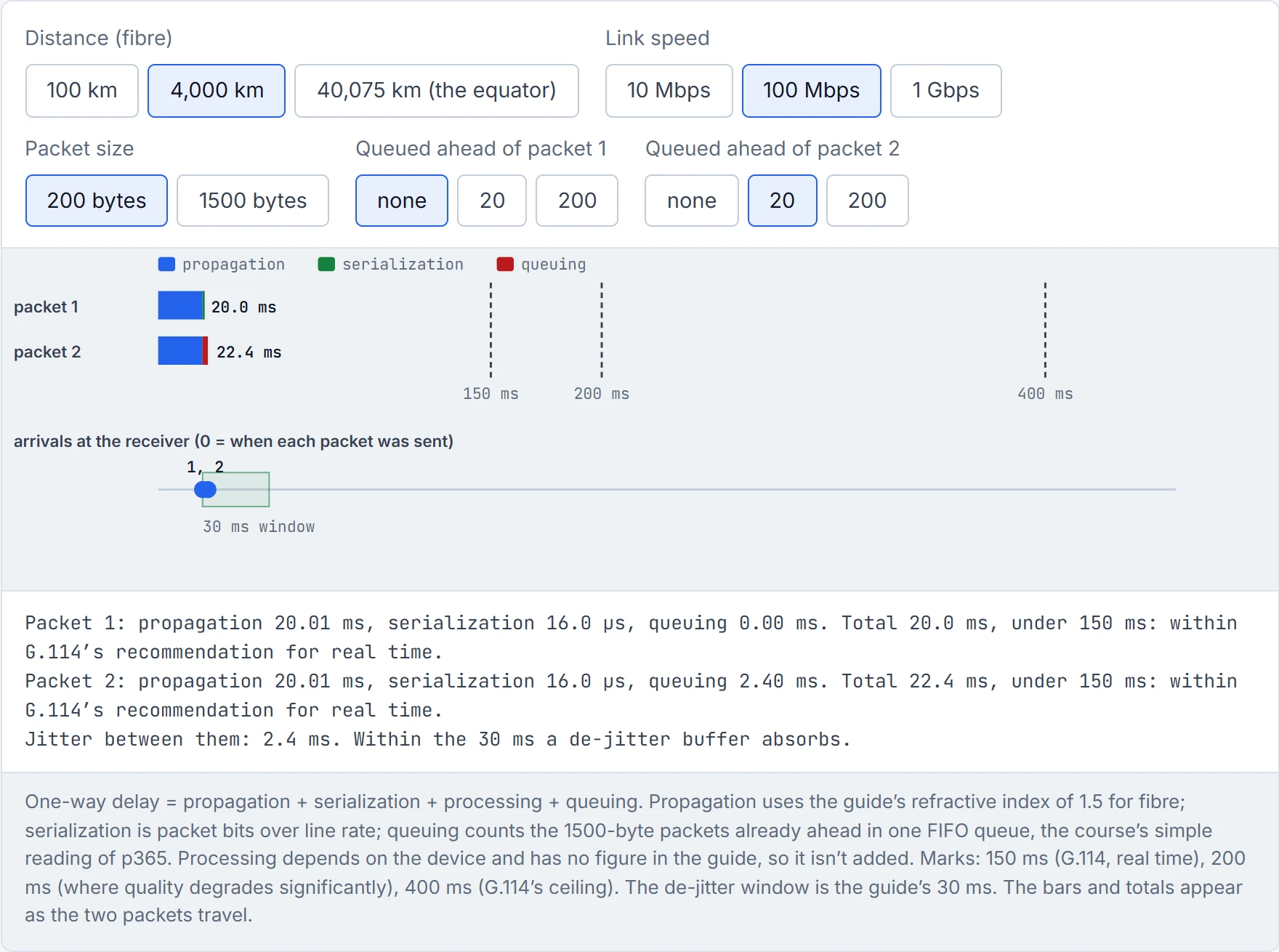
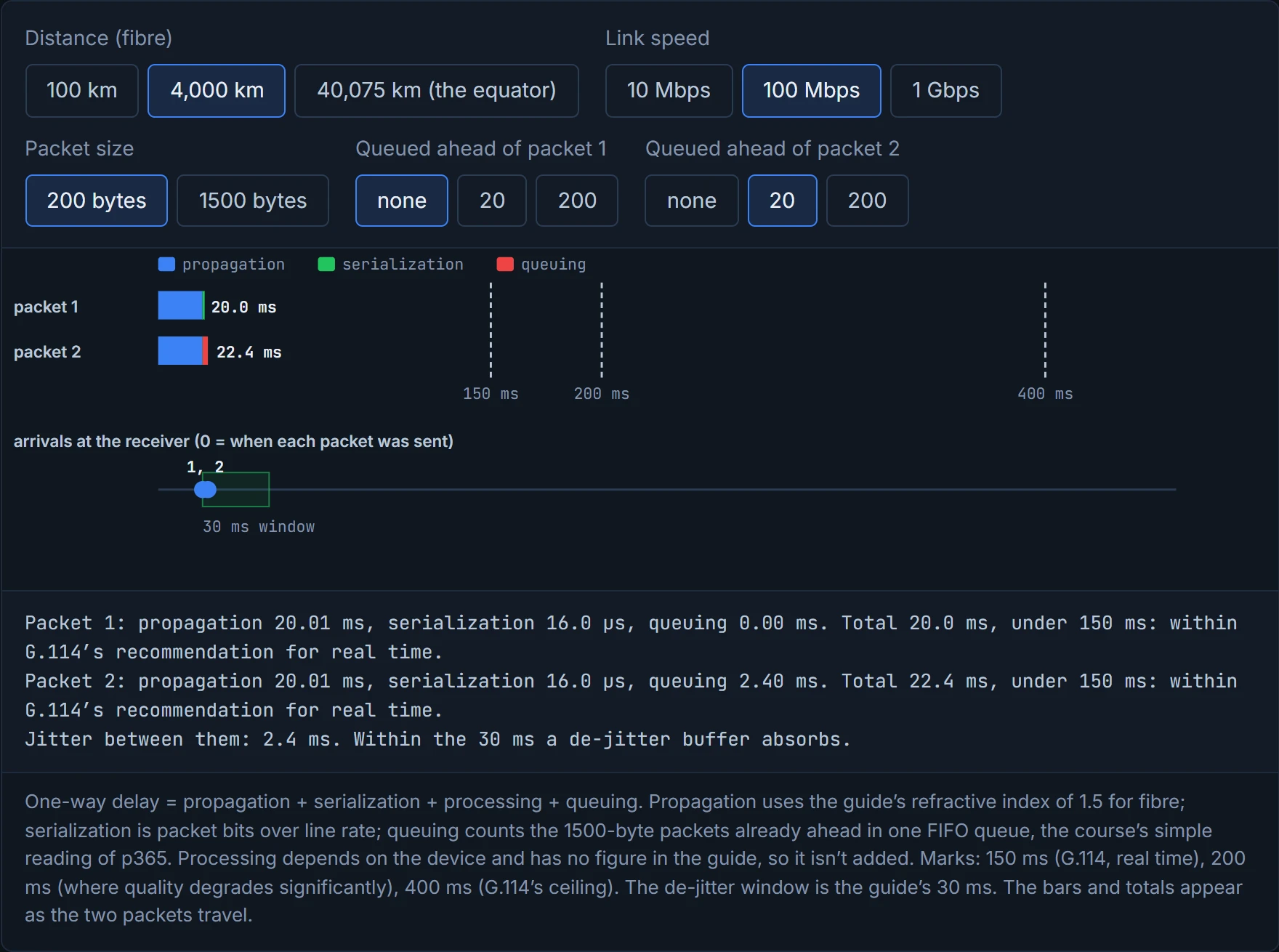
A 30 ms de-jitter buffer is the network's most patient friend, and even it won't wait for a packet stuck behind 200 others on a 10 Mbps link.
Loss "is usually a result of congestion on an interface", and the guide gives four ways to prevent it: a faster link, like a wider road; congestion avoidance and congestion management (05-4), like managing a queue that's already formed; policing, which drops low-priority packets so high-priority traffic gets through; and shaping, which delays packets instead of dropping them (both 05-3).
Shaping "is not recommended for real-time traffic because it relies on queuing that can cause jitter", and standard shaping can't smooth micro-bursts that happen within microseconds; that needs microsecond, low-burst shaping. It's like a busy restaurant: you can build a bigger kitchen, manage the queue at the door, turn some customers away, or make them wait in the bar, and the ones waiting in the bar won't all be happy.
Shaping is the network saying "please hold, your call is important to us", which is fine for email and useless for a phone call.
The guide names three models, and they differ in who decides what traffic gets:
| Model | Who decides | Price |
|---|---|---|
| best effort | nobody: no QoS, for traffic that doesn't need special treatment | real time suffers under congestion |
| IntServ | each application signals the network and reserves resources end to end (RSVP) | state for every flow on every node; unused reservations are wasted |
| DiffServ | the network sorts traffic into classes and treats each class hop by hop; designed to fix the other two's limits, and highly scalable | no end-to-end guarantee |
Quiz Q3 lists "expedited forwarding" as a model; it isn't one, it's a DiffServ behaviour (05-2); Q4's model that needs a signalling protocol is IntServ; Q5's most popular is DiffServ.
IntServ was built for voice and video that need guarantees: applications signal their requirements, RSVP reserves the resources along the path, and call admission control keeps other traffic off the reservation. Its weakness is scale: every node, endpoints included, keeps RSVP state "for every single flow", so it "cannot scale well" on networks with thousands or millions of flows; and over long distances, setting up the reservation itself takes time. RSVP ends up like a restaurant that takes a booking for every single diner: it works for a small place, and falls apart at a stadium.
How RSVP books the path (Figure 14-1), in the directions RFC 2205 gives: each sender sends Path messages "downstream ... following the paths of the data", and each node keeps path state that includes "the unicast IP address of the previous hop node"; each receiver then sends Resv messages "upstream towards the senders", hop by hop back along that path, reserving bandwidth for the flow the receiver asked for, sender to receiver: RSVP "makes reservations for unidirectional data flows", and "the receiver of a data flow initiates and maintains the resource reservation used for that flow". Path messages are even "sent with the same source and destination addresses as the data". Reserving the other direction too means a second set of Path messages, which "doubles the RSVP state on each networking device". Careful: the guide's own text says the Resv goes "toward the receivers" and reserves for traffic "from the receiver hosts to the sender hosts"; both are backwards. The guide's next sentence gives it away: to reserve the other direction, "the hosts on the right side need to follow the same procedure", which only makes sense if the first reservation ran left to right. It's just like a scout walking a route and chalking every junction (Path, leaving the previous hop), then the diner at the far end walking back along the chalk marks to book a table at each stop (Resv).
Continue the lesson
The whole lesson, with its drawings and its questions. The rest of this section and 9 more after it.