
Redundancy using IPv6 RS/RA
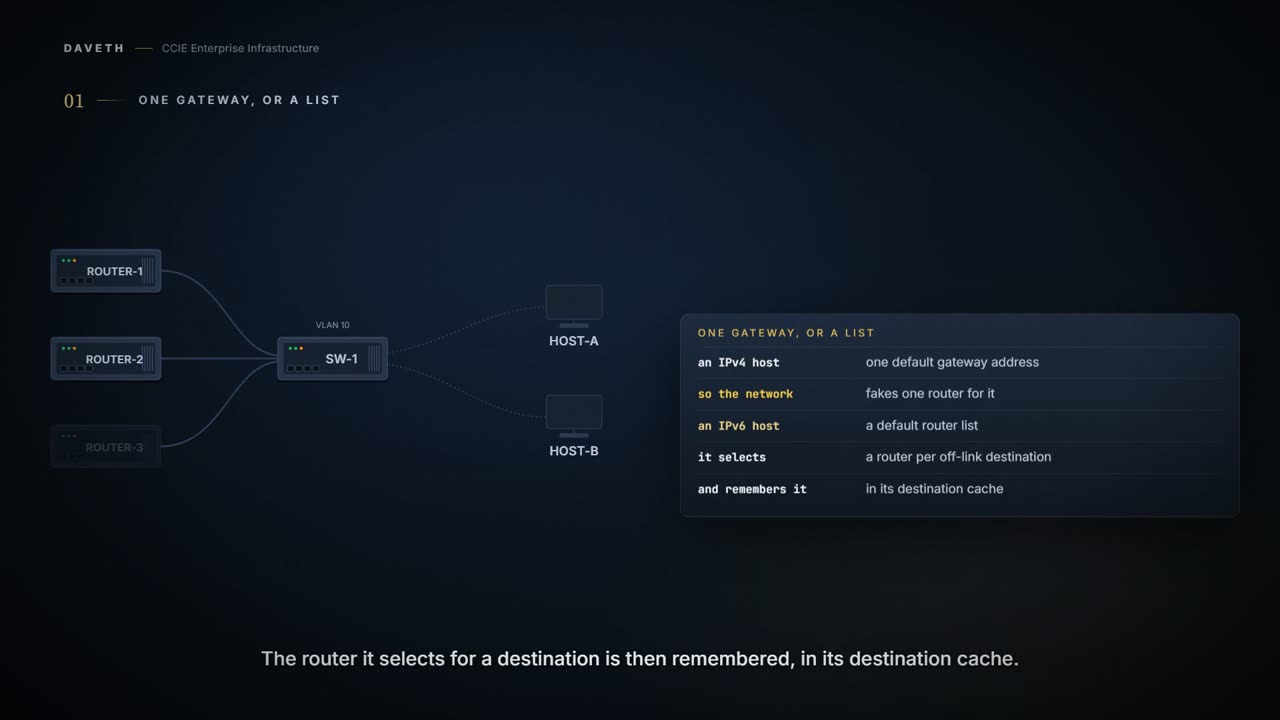
An IPv4 host has one gateway, so the network fakes a single router. An IPv6 host keeps a default router list, built from router advertisements, and selects from it, preferring routers that are reachable or probably reachable. Each RA carries a default router preference, set with ipv6 nd router-preference. A new router advertising before it is configured can attract hosts and lose their traffic.
By Arif, founder of Daveth · Updated
The full 7 min walkthrough is in Daveth Pro (Network). See what the plan opens
What this page answers
How does an IPv6 host choose its default router?
It keeps a default router list learned from router advertisements, prefers routers that are reachable or probably reachable, and can use the same router every time or cycle through the list. The choice is cached per destination. Read it in “How the host chooses”
What is IPv6 default router preference?
A value carried in router advertisements, set by ipv6 nd router-preference on the interface, that tells hosts how much to prefer this router over others on the link. Read it in “How the host chooses”
Why can a new IPv6 router black-hole traffic?
A router connected before its routing is configured still sends RAs, so hosts may adopt it as a default router and their traffic disappears. A low router preference on it avoids that. Read it in “The router nobody finished”
One gateway, or a list
4.5.a.i started from one fact: a host has one default gateway address, so the network has to fake a single router for it. Does that hold in IPv6?
An IPv6 host maintains a default router list from which it selects a router for traffic to offlink destinations. The selected router for a destination is then cached in the destination cache.
A list, and the host selects. Nobody has to present a shared virtual address to a host that already expects several routers.
So where does the list come from?
Hosts discover and select default devices by listening to Router Advertisements (RAs). Typical default device selection mechanisms are suboptimal in certain cases, such as when traffic engineering is needed.
The switch supports NDP for IPv6, a protocol running on top of ICMPv6, and static neighbor entries for IPv6 stations that do not support NDP. The IPv6 neighbor discovery process uses ICMP messages and solicited-node multicast addresses to determine the link-layer address of a neighbor on the same network (local link), to verify the reachability of the neighbor, and to keep track of neighboring routers.
Count the jobs in that last sentence. Resolving addresses is the one you know from ARP; the third is keeping track of neighboring routers, and that is the redundancy.
How the host chooses
RTR-1 and RTR-2 both advertise on Vlan10, and nothing is configured. Which one does a host use?
NDP for IPv6 specifies that routers that are reachable or probably reachable are preferred over routers whose reachability is unknown or suspect. For reachable or probably reachable routers, NDP can either select the same router every time or cycle through the router list.
And with nothing configured, what do their RAs carry?
Router advertisement messages are sent with the default router preference (DRP) configured by the ipv6 nd router-preference interface configuration command. If no DRP is configured, RAs are sent with a medium preference.
Computed by this course from the state: HOST-A’s list with two routers advertising. No command prints this table.
HOST-A default router list
router  reads as  reachability        may select
RTR-1   medium    reachable           yes
RTR-2   medium    reachable           yes
traffic delivered
Look at the last column: either router, and the chapter allows the same one every time or a cycle through them.
The IPv6 default router preference feature provides a coarse preference metric (low, medium, or high) for default devices.
A DRP is useful when two routers on a link might provide equivalent, but not equal-cost routing, and policy might dictate that hosts should prefer one of the routers.
Configuration: RTR-1 preferred, in the form the Catalyst 9300 chapter prints; names and interface are this course’s own.
RTR-1# configure terminal
RTR-1(config)# interface Vlan10
RTR-1(config-if)# ipv6 nd router-preference high
RTR-1(config-if)# end
ipv6 nd router-preference {high | medium | low} Specifies a DRP for the router on the switch interface.
From elsewhere: the DRP configuration example. The values in it come from elsewhere, not from this scenario.
Device> enable
Device# configure terminal
Device(config)# interface gigabitethernet1/0/1
Device(config-if)# ipv6 nd router-preference high
Device(config-if)# end
Nobody touched RTR-2, so it still sends medium.
Medium, not bottom. So high on RTR-1 is enough by itself; low on RTR-2 would be a second decision with its own consequence.
Now the second host on Vlan10, HOST-B.
Computed by this course from the state: both hosts’ lists after RTR-1 is set to high. No command prints this table.
HOST-A default router list
router  reads as  reachability        may select
RTR-1   high      reachable           yes
RTR-2   medium    reachable           no
traffic delivered

HOST-B default router list
router  reads as  reachability        may select
RTR-1   ignored   reachable           yes
RTR-2   ignored   reachable           yes
traffic delivered
The DRP of a default device is signaled in unused bits in RA messages. This extension is backward compatible, both for devices (setting the DRP bits) and hosts (interpreting the DRP bits). These bits are ignored by hosts that do not implement the DRP extension.
Similarly, the values sent by devices that do not implement the DRP extension will be interpreted by hosts that do implement it as indicating a “medium” preference. DRPs need to be configured manually.
Notice the two directions in that pair of sentences. A router without the extension is read as medium; a host without it reads nothing at all.
Two doors out of a room, one marked preferred and one marked alternative. Nobody held an election and no door is in charge. Each person reads the signs and leaves by a door that works for them, and somebody who never looks up walks out of whichever one they were nearest.
So two laptops on one VLAN can recover at different moments and both be behaving correctly. You set a preference on the router. Whether it changed anything is a question about each host, one host at a time, and the host is the one place you were not looking.
Where the exits stop: a person who reads a sign that turns out to be wrong can walk back and try the other door. A host holds the gateway it chose until the lifetime it was given runs out, which is why the next section is about a router that stops rather than a router that lies.
Configures a DRP for a router on a specific interface
The 17.x module prints that syntax with its closing brace missing; the Catalyst 9300 chapter prints it whole, which is the form quoted above.
The router nobody finished
RTR-3 is cabled to the VLAN before anyone has configured its routing. It is on the link, and it advertises. What happens?
A new help desk puts its sign up before any staff have arrived. The sign is genuine, the desk is real, and anybody who queues there is going to have a quiet afternoon.
Accidentally deploying a new device—Deploying a new device before it has been fully configured could lead to hosts adopting the new device as a default device and traffic disappearing. Network managers may want to indicate that some devices are more preferred than others.
Computed by this course from the state: what each router advertises, and whether it forwards. No command prints this table.
router  configured  RAs carry  sending  forwards
RTR-1   high        high       yes      yes
RTR-2   none        medium     yes      yes
RTR-3   none        medium     yes      no
Computed by this course from the state: HOST-B’s list with RTR-3 advertising. No command prints this table.
HOST-B default router list
router  reads as  reachability        may select
RTR-1   ignored   reachable           yes
RTR-2   ignored   reachable           yes
RTR-3   ignored   reachable           yes
traffic depends on which it selects
HOST-A is safe only because RTR-1 is high. Had nothing been configured, RTR-3 would be medium beside the other two.
The same quote names the remedy: indicate that some routers are more preferred than others. So give RTR-3 low until it is finished. Does that keep HOST-B off it?
Configuration: RTR-3 marked low while it is unfinished, in the form the Catalyst 9300 chapter prints; names and interface are this course’s own.
RTR-3# configure terminal
RTR-3(config)# interface Vlan10
RTR-3(config-if)# ipv6 nd router-preference low
RTR-3(config-if)# end
Computed by this course from the state: the routers, and HOST-B’s list, after RTR-3 is set to low. No command prints this table.
router  configured  RAs carry  sending  forwards
RTR-1   high        high       yes      yes
RTR-2   none        medium     yes      yes
RTR-3   low         low        yes      no

HOST-B default router list
router  reads as  reachability        may select
RTR-1   ignored   reachable           yes
RTR-2   ignored   reachable           yes
RTR-3   ignored   reachable           yes
traffic depends on which it selects
Setting RTR-3 low changed nothing for HOST-B. By this course’s reading, a preference protects only hosts that read it; for the rest, keep a router off the link until it can forward.
Continue the lesson
The whole lesson, with its drawings and its questions. 5 more sections after the ones above.