
Troubleshooting redistribution (timed)
The redistribute command is there and the routes are not: four timed tickets ask why, and each has an output saying the router is redistributing. A route can stop in four places, and each protocol has its own trap: into EIGRP a missing metric leaves the seed at infinity; into OSPF the seed defaults to 20 and the type to E2; from BGP only eBGP routes cross by default.
By Arif, founder of Daveth · Updated
The full 12 min walkthrough is in Daveth Pro (Network). See what the plan opens
What this page answers
Why are redistributed routes missing from EIGRP?
Usually the metric: the default seed into EIGRP is infinity, so without a metric on the redistribute line or a default-metric, the routes are unusable. Check the line's match and route-map options too. Read it in “Into EIGRP: what a crossing leaves behind”
What are the defaults when redistributing into OSPF?
The seed metric defaults to 20 and the metric type to external type 2, E2, where every router keeps the seed. The routes appear on other routers as type 5 LSAs. Read it in “Into OSPF: subnets , and a type 5 as the receipt”
Why are iBGP routes not redistributed into the IGP?
From BGP into OSPF, EIGRP or RIP, only eBGP routes go by default; iBGP routes need bgp redistribute-internal under router bgp. Read it in “Into BGP: read the match list”
Four tickets, one drawing
The redistribute command is there. The routes aren't. Why? That's this lesson's question, and you'll answer it four times against a clock, then once more on our own network. Every ticket has an output that says the router is redistributing. Watch what that's worth.
Four trouble tickets, with the differences between redistributing into EIGRP, OSPF and BGP, for IPv4 and IPv6, in between. The tickets show a process you can follow in the real world or in an exam, and all four use one network:
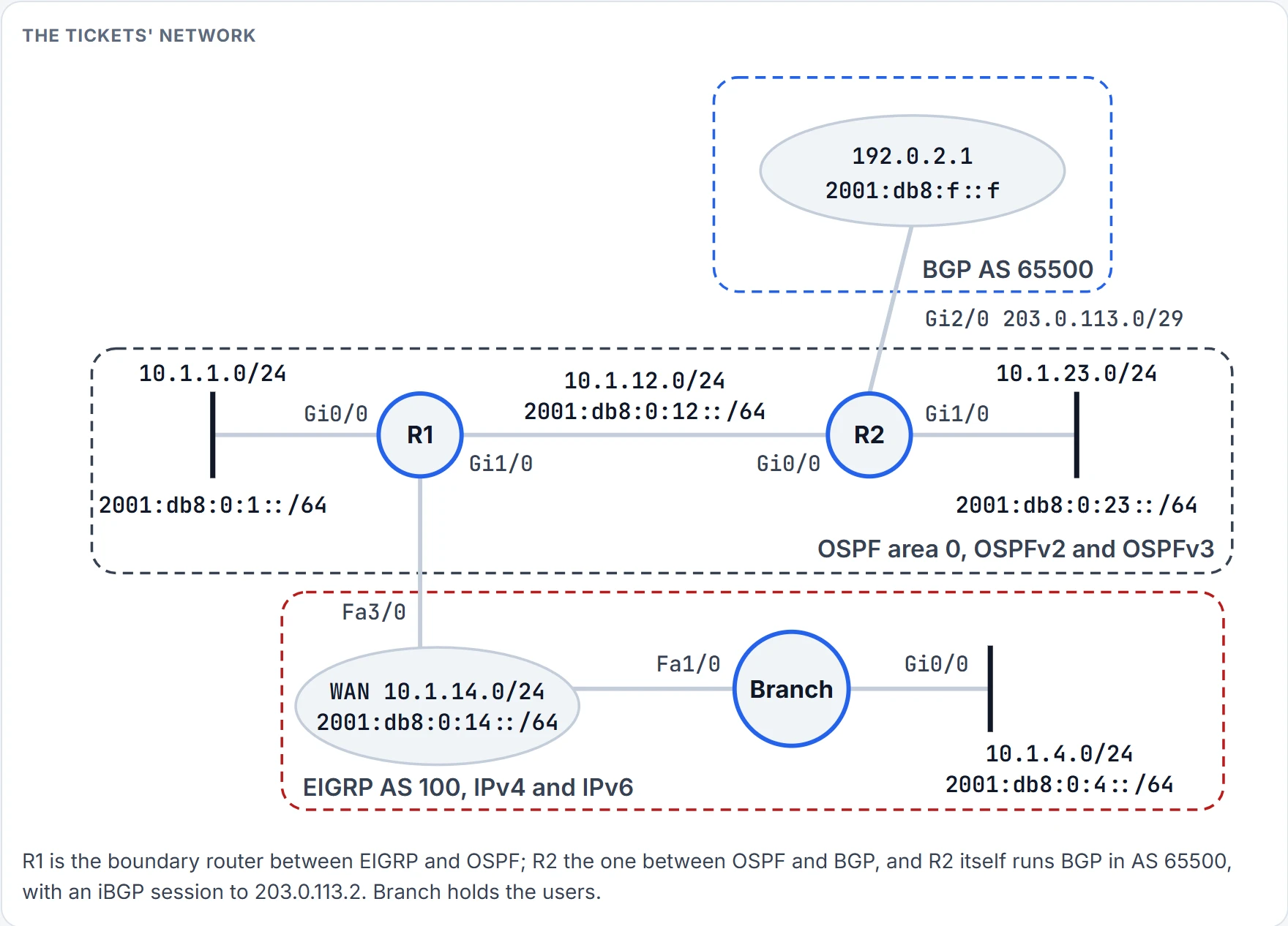
R1 sits in the middle. Its Gi0/0 is on 10.1.1.0/24 and 2001:db8:0:1::/64, its Gi1/0 on 10.1.12.0/24 and 2001:db8:0:12::/64 towards R2, both in OSPF area 0, OSPFv2 and OSPFv3. R1's Fa3/0 goes into a WAN cloud, 10.1.14.0/24 and 2001:db8:0:14::/64, and through it to Branch's Fa1/0; Branch's Gi0/0 holds the users, 10.1.4.0/24 and 2001:db8:0:4::/64. R1, the WAN and Branch are EIGRP AS 100, IPv4 and IPv6. R2's Gi1/0 is on 10.1.23.0/24 and 2001:db8:0:23::/64, also in area 0, and its Gi2/0, 203.0.113.0/29, faces BGP AS 65500, where a cloud holds 192.0.2.1 and 2001:db8:f::f. So R1 is the boundary router between EIGRP and OSPF, and R2 the one between OSPF and BGP.
How long do you get? The course's exam-day lesson gave you a rough figure: sims, simlets and testlets take about 6 to 8 minutes each, and the time check adds 7 for every one you've answered. That's experience, not a Cisco rule. Each ticket here gets a budget of ours, four or five minutes.
Now the queue. Four complaints:
- Ticket 17-1: users in the IPv4 Branch site can't reach anything outside the branch.
- Ticket 17-2: users in 10.1.23.0/24 can't reach resources in 10.1.4.0/24.
- Ticket 17-3: IPv6 users in 2001:db8:0:4::/64 can't reach resources in 2001:db8:0:1::/64.
- Ticket 17-4: users in BGP AS 65500 can't reach IPv4 resources in EIGRP AS 100, though they can reach the OSPFv2 domain, and you can only get onto R2.
Before any command, triage all four from the drawing. For each, write down which boundary router has to carry the route, which protocol it has to go into, and which family. Each ticket below starts by checking your triage.
Ticket 17-1, four minutes: "Redistributing: ospf 1"
Your triage: Branch is in EIGRP, everything it wants is in OSPF or behind it, so the routes have to go into EIGRP at R1, IPv4. Budget: four minutes.
The walk starts at the complaining router. Branch's table holds connected and local routes, nothing else:
Branch# show ip route
...output omitted...
      10.0.0.0/8 is variably subnetted, 4 subnets, 2 masks
C        10.1.4.0/24 is directly connected, GigabitEthernet0/0
L        10.1.4.4/32 is directly connected, GigabitEthernet0/0
C        10.1.14.0/24 is directly connected, FastEthernet1/0
L        10.1.14.4/32 is directly connected, FastEthernet1/0
Next, a hypothesis: maybe Branch never formed an EIGRP neighbor relationship with R1. show ip eigrp neighbors on Branch, under "EIGRP-IPv4 VR(TSHOOT) Address-Family Neighbors for AS(100)", lists 10.1.14.1 on Fa1/0. So Branch has an EIGRP neighbor, 10.1.14.1, and show cdp neighbors detail says that address is R1. A neighbor and no routes, so filters next. Branch's show ip protocols reads "Incoming update filter list for all interfaces is not set": Branch has no incoming route filter. The same command on R1 reads "Outgoing update filter list for all interfaces is not set": R1 has no outgoing one. Then R1's show ip protocols again, read for its redistribution:
R1# show ip protocols
*** IP Routing is NSF aware ***
Routing Protocol is "eigrp 100"
 Outgoing update filter list for all interfaces is not set
 Incoming update filter list for all interfaces is not set
 Default networks flagged in outgoing updates
 Default networks accepted from incoming updates
 Redistributing: ospf 1
 EIGRP-IPv4 Protocol for AS(100)
   Metric weight K1=1, K2=0, K3=1, K4=0, K5=0
   NSF-aware route hold timer is 240
..output omitted..
Look at Redistributing: ospf 1. OSPF process 1 is being redistributed into EIGRP AS 100, it says. And every check so far says Branch isn't learning a single redistributed route.
Hold both of those. The router says it's redistributing. Nothing has crossed. The line reports configuration, not routes. show ip protocols reads like an order confirmation: it repeats what you ordered, and it'll confirm an order the warehouse can't fill.
So ask the one output that can't echo the configuration: EIGRP's own table on R1. None of the OSPF routes are in it:
R1# show ip eigrp topology
EIGRP-IPv4 Topology Table for AS(100)/ID(10.1.14.1)
P 10.1.14.0/24, 1 successors, FD is 28160
        via Connected, FastEthernet3/0
P 10.1.4.0/24, 1 successors, FD is 28416
        via 10.1.14.4 (28416/2816), FastEthernet3/0
Two entries, both EIGRP's own, and not one "via Redistributed". Are there OSPF routes to take? A route has to be in the table to be redistributed, so check it. There are: O 10.1.23.0/24 [110/2], O E2 192.0.2.1 [110/1], and the connected 10.1.1.0/24 and 10.1.12.0/24 on OSPF's two interfaces, next to EIGRP's D 10.1.4.0/24 [90/28416]. (That [110/1] is BGP's seed into OSPF, 1, which says R2 redistributes BGP into OSPF.)
Then the line itself. redistribute ospf 1, and no metric. The metric is mandatory with EIGRP: without default-metric, a metric on the line or one in a route map, the routes are unreachable and aren't redistributed:
R1# show run | section router eigrp
router eigrp 100
 network 10.1.14.1 0.0.0.0
 redistribute ospf 1
ipv6 router eigrp 100
 redistribute ospf 1 metric 100000 100 255 1 1500 include-connected
Notice what the IPv6 line tells you: it carries a metric, which is why only IPv4 broke.
You knew the rule from the first redistribution lesson: EIGRP's default seed is infinity, and routes set to infinity aren't installed in the EIGRP topology table. Unreachable, and not advertised to the other routers; this output shows it's stronger than that: the routes aren't even in R1's own topology table. Static and connected routes and another EIGRP AS are an exception, with a catch you'll meet in the next section.
The fix is to issue redistribute ospf 1 again with the metric values 100000 100 255 1 1500, and R1's topology table fills: 10.1.12.0/24, 10.1.23.0/24, 192.0.2.1/32 and 10.1.1.0/24, each via Redistributed at 51200. That's 256 × (100 + 100), the classic EIGRP formula, because R1 runs classic mode (router eigrp 100): the first 100 is the bandwidth term, 10^7 / 100,000 Kbps, and the second the seed's delay, 100 tens of microseconds. Branch now lists the externals and its users connect:
Branch# show ip route
...output omitted...
D EX     10.1.1.0/24 [170/614400] via 10.1.14.1, 00:02:58, FastEthernet1/0
D EX     10.1.12.0/24 [170/614400] via 10.1.14.1, 00:02:58, FastEthernet1/0
D EX     10.1.23.0/24 [170/614400] via 10.1.14.1, 00:02:58, FastEthernet1/0
D EX     192.0.2.1 [170/614400] via 10.1.14.1, 00:02:58, FastEthernet1/0
614,400 where R1 said 51,200? Don't spend your budget on it. R1 runs classic mode and Branch runs named mode, the "VR(TSHOOT)" in its neighbor output, so this is the wide metric: 65,536 × (100 + 1,100) / 128, the same bandwidth term of 100 (10^7 / 100,000) plus the seed's 1,000 µs and the FastEthernet hop's 100 µs.
That walk typed nine commands before the fix. Two of them found it: R1's topology table, with nothing redistributed in it, and R1's configuration, with no metric on the line. Most of the rest ruled things out: Branch's four commands, R1's filter check, and R1's routing table (the routes were there to take). R1's second show ip protocols confirmed the one thing that wasn't in doubt, that the line exists. The drawing pointed at R1 before the first command.
Four places a route can stop
Ticket 17-1's route stopped at the redistribute line. It could have stopped earlier, or later. Here's where.
Redistribution lets routes learned from one source (static routes, connected routes, a routing protocol) be injected into a routing protocol; mutually redistributed, each protocol's routes go into the other. The router that joins two or more routing domains and does the redistributing is the boundary router, and it can redistribute static, connected and protocol routes into another protocol. Picture it: R1 in OSPF, R3 in EIGRP, R2 between them as the boundary router. The examples in the next three sections use that layout, not the tickets' drawing: R1 and R2 share OSPF, with 10.1.1.0/24 and 10.1.12.0/24 among its networks, and R2 and R3 share EIGRP on 10.1.23.0/24, with 10.1.3.0/24 behind R3.
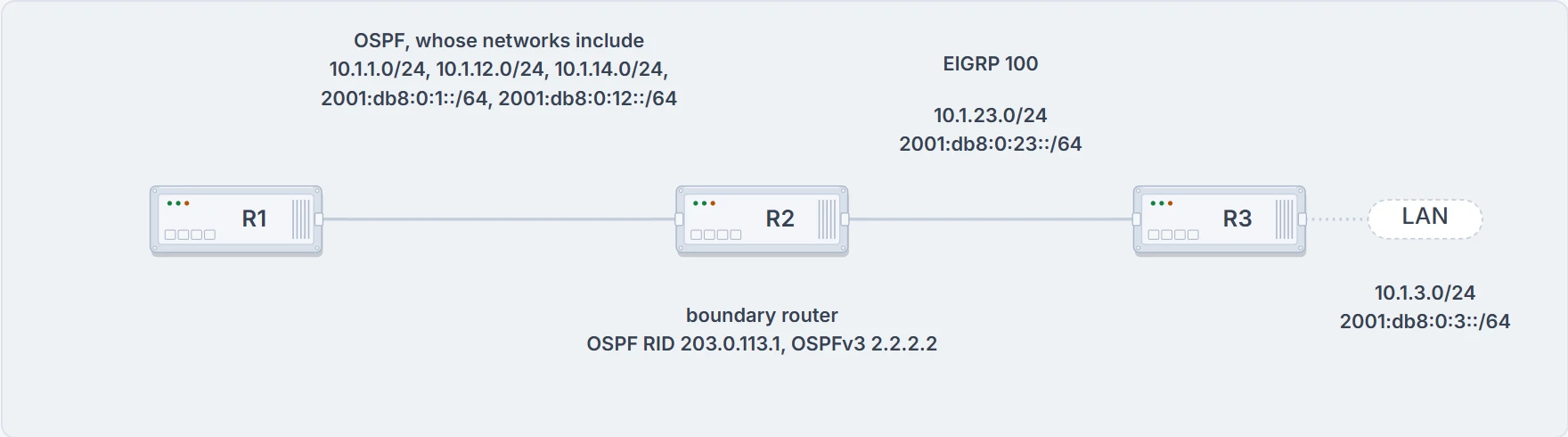
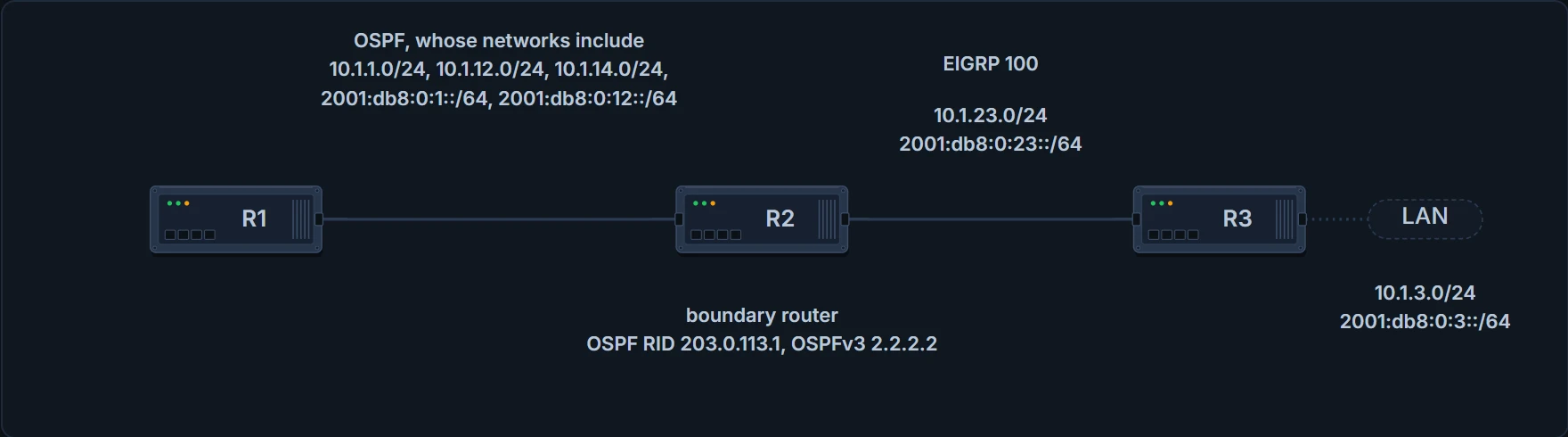
The layout the next three sections' outputs come from: R2 is the boundary router, R1 is on its OSPF side and R3 on its EIGRP side.
Now the one sentence the rest of the lesson hangs on. Redistribution happens from the routing table into a routing protocol's data structure: the EIGRP topology table, the OSPF LSDB. Routes go two ways: the source protocol installs them from its data structure into the IP routing table, and redistribution takes them from the table into the destination protocol's. Redistribution is taking routes from the IP routing table, as learned by one protocol, and injecting them into another. So if the route isn't in the routing table, it can't be redistributed. And then it isn't a redistribution problem at all: redistributing EIGRP into OSPF with the EIGRP route missing from the table is an EIGRP problem, and you solve that first.
Then the metric. Protocols measure differently, so a route going into a protocol needs a metric that protocol uses: cost on OSPF's side, bandwidth and delay on EIGRP's. That metric is the seed metric, and it carries relative reachability between protocols that can't read each other's. You set it one of three ways: default-metric, the metric parameter on redistribute, or a route map on redistribute. Set more than one and the route map's wins, then the line's metric, then default-metric, the same order you saw in the first redistribution lesson. Set none and a default applies:
- EIGRP: unreachable. Configure no seed and the redistributed route isn't reachable, so it isn't advertised to the other routers. RIP's default is unreachable too, should you meet it.
- OSPF: 20, or 1 for a route from BGP.
- BGP: it keeps the IGP's exact metric.
EIGRP needs no metric when it redistributes static or connected routes, nor from another EIGRP AS: the original metric carries over. The seed table in the first redistribution lesson gives EIGRP infinity and doesn't mention static or connected routes, and we haven't confirmed which is right on a current router. A seed on every line into EIGRP from anything but another EIGRP AS means you never depend on it.
The two prerequisites follow. The route has to be installed in the border router's routing table by the protocol being redistributed, and the destination protocol needs a reachable metric to give it. They turn into four troubleshooting targets, in the order a route meets them:
- The source routing protocol. Has it learned the route? Ask its own data structures, with its own show commands.
- Route selection. Is the source protocol's route actually in the routing table? It has to be.
- The redistribution configuration. In the table and still not redistributed: check the metric, any route filtering on the line, and the syntax, down to the right process ID or AS number.
- The destination routing protocol. Redistributed, and the neighbors still haven't learned it: troubleshoot the destination protocol the usual way, remembering the route may be external and the protocol may treat externals differently; the EIGRP and OSPF troubleshooting lessons cover the usual way.
Ticket 17-1 stopped at the third. Before you read on, guess where the other three stop.
Into EIGRP: what a crossing leaves behind
Into EIGRP for IPv4, the line takes a metric or a route-map, and from OSPF a match as well, for internal routes, external routes, NSSA externals or a combination: the help list reads match, metric, route-map. The most common issue here is the metric: the default seed is infinity, and forget to set one and the routes aren't advertised to the other routers in the AS. (Your metrics can also make traffic take the long way with several redistribution points: the last lesson.) And a wrong route map, or an error in one, means routes aren't redistributed properly.
EIGRP for IPv6 takes the same match, metric and route-map, plus include-connected. The reason, in a line: in IPv4 the networks of the local interfaces running the redistributed process go across too, and in IPv6 they don't unless you add the keyword.
Now the evidence, and before each output, ask what it can prove.
show ip protocols on the boundary router tells you which protocols are being redistributed into EIGRP for IPv4. Under Routing Protocol is "eigrp 100" it prints the line Redistributing: ospf. It proves the line exists. Its printed lines carry no seed, and we haven't confirmed whether the rest of the output prints one. And it can't tell you whether a route crossed: Ticket 17-1 printed the same line with nothing across.
show ip eigrp topology names the routes that went into the EIGRP process by redistribution: they say "via Redistributed". In a working example, 10.1.12.0/24, 10.1.14.0/24 and 10.1.1.0/24 each show FD 2560000256, via Redistributed (2560000256/0), next to EIGRP's own 10.1.3.0/24 via 10.1.23.3 (3072/2816) and 10.1.23.0/24 via Connected. This is the receipt. A route with no seed has no entry here at all, as Ticket 17-1 showed.
Look at that FD. 2,560,000,256 is 256 × (10,000,000 + 1), the seed of 1 1 1 1 1 you'll see in a minute: a bandwidth of 1 Kbps and a delay of 10 µs. A terrible seed. It's still a seed, and the route crossed. No seed, and nothing does.
show ip route <address> on the boundary router says how the route is known, how it's being redistributed, and the EIGRP metric used at the redistribution point:
R2# show ip route 10.1.1.0
Routing entry for 10.1.1.0/24
 Known via "ospf", distance 110, metric 1
 Redistributing via eigrp 100, ospf
 Advertised by eigrp 100 metric 1 1 1 1 1
! the rest is omitted here
Three lines worth reading. Known via is the owner, the first redistribution lesson's whole story. Redistributing via eigrp 100, ospf is how the route is being redistributed. Advertised by eigrp 100 metric 1 1 1 1 1 is how it's being advertised: the keywords of the redistribute line that covers this route, seed included. Both report configuration applied to the route, the way show ip protocols reports it for the whole process. Neither is a receipt. The routing-table lesson printed Redistributing via eigrp 100 on a plain connected route, in an example about administrative distance with no redistribution in it, and the EIGRP metric lesson printed it on an ordinary internal EIGRP route. So the line says what the router is set up to do with the route, not whether a route crossed. Advertised by is a little more particular: in these outputs it appears on a route the line covers, so its absence is worth noticing. Its presence still isn't a receipt. Hold that thought; it matters in Ticket 17-2.
Downstream, on the other routers in the AS, the redistributed routes carry AD 170 and the code D EX: D EX 10.1.1.0/24 [170/2560000512] via 10.1.23.2, and the same for 10.1.12.0/24 and 10.1.14.0/24. One GigabitEthernet hop added 1 to the seed's delay: 256 × (10,000,000 + 2).
IPv6 is more talkative. show ipv6 protocols gives the protocol, the seed metric and whether connected networks are included: Distance: internal 90 external 170 and, under Redistribution, Redistributing protocol OSPF 1 with metric 1 1 1 1 1 include-connected. So in IPv6 a missing seed or a missing include-connected shows in the protocols output itself; the IPv4 output's printed lines have none. show ipv6 eigrp topology marks the redistributed routes the same way: 2001:DB8:0:1::/64 and 2001:DB8:0:12::/64 via Redistributed (2560000256/0), 2001:DB8:0:3::/64 via a link-local next hop (3072/2816), and 2001:DB8:0:23::/64 via Connected. On the other routers they're AD 170, code EX: EX 2001:DB8:0:1::/64 [170/2560000512] via FE80::C802:AFF:FE88:1C.
Into OSPF: subnets, and a type 5 as the receipt
Redistributing into OSPF gives you more options than the other protocols. metric sets the seed; the default is 20, so it isn't mandatory, and forget it and the routes still reach the other routers. metric-type picks the external type: type 2 by default, E2 in the table, where every router keeps the seed; type 1, E1, where each router adds the cost of the links to the redistribution point. nssa-only keeps the routes inside the NSSA, and route-map gives finer control. And tag adds a numeric ID you can filter or work on later, the last lesson's tool.
subnets is extremely important. Without it, only classful networks go: a class A address with a /8 mask, a class B with /16, a class C with /24. With it, classful and classless both go, so for any subnet it's mandatory. So when the classful networks made it into OSPF and one /26 didn't, look for a missing subnets before anything else. The help list: metric, metric-type, nssa-only, route-map, subnets, tag.
OSPFv3 adds include-connected and loses subnets. OSPFv2 takes the networks of the interfaces running the redistributed process; OSPFv3 doesn't, unless you ask. And there's no subnets because classful and classless don't exist in IPv6. The help list: include-connected, metric, metric-type, nssa-only, route-map, tag. You met all three in the first redistribution lesson; here they're the things to check when the routes don't arrive.
The evidence. show ip protocols tells you what's redistributed into OSPFv2:
R2# show ip protocols
...output omitted...
Routing Protocol is "ospf 1"
 Outgoing update filter list for all interfaces is not set
 Incoming update filter list for all interfaces is not set
 Router ID 203.0.113.1
 It is an autonomous system boundary router
 Redistributing External Routes from,
   eigrp 100, includes subnets in redistribution
! the rest is omitted here
Read the redistribution line to its end: "includes subnets in redistribution" is the keyword's own trace in the output. Our reading is that its absence would be the first hint of a missing subnets, though we haven't confirmed it; either way, it reports the line, not a route.
The receipt is the LSDB. Redistributed routes go into a normal area as type 5 LSAs, and into an NSSA or totally NSSA as type 7, converted to type 5 at an ABR. show ip ospf database shows the routes injected into the LSDB; in a working example that's 10.1.3.0 and 10.1.23.0, listed under Type-5 AS External Link States with advertising router 203.0.113.1, the ASBR.
show ip route <address> on the ASBR says how the route is known, how it's redistributed and how it's advertised; here it's known through EIGRP 100 and redistributed into OSPF 1 with subnets:
R2# show ip route 10.1.3.0
Routing entry for 10.1.3.0/24
 Known via "eigrp 100", distance 90, metric 3072, type internal
 Redistributing via eigrp 100, ospf 1
 Advertised by ospf 1 subnets
! the rest is omitted here
Advertised by ospf 1 subnets is how the route is being advertised: the line's own keywords, repeated on the route. Downstream, redistributed routes are AD 110 and O E2, or E1 if you changed the type, and O N1 or O N2 inside an NSSA: O E2 10.1.3.0/24 [110/20] via 10.1.12.2 and O E2 10.1.23.0/24 [110/20].
OSPFv3, the same three looks. show ipv6 protocols states the protocol, the seed and whether connected networks are included: Redistributing protocol eigrp 100 with metric 10 include-connected. show ipv6 ospf database on the ASBR lists the external type 5s as OSPFv2 does: under Type-5 AS External Link States, advertising router 2.2.2.2, prefixes 2001:DB8:0:3::/64 and 2001:DB8:0:23::/64. And the other routers hold them at AD 110, code OE2, OE1 for type 1, ON1 or ON2 in an NSSA: OE2 2001:DB8:0:3::/64 [110/10] and OE2 2001:DB8:0:23::/64 [110/10]. The 10 is the seed that line set, not OSPFv3's default 20.
Into BGP: read the match list
One note first, and it runs the other way. From BGP into OSPF, EIGRP or RIP, only eBGP routes go by default; iBGP routes need bgp redistribute-internal under router BGP, the first redistribution lesson's rule. Look at the drawing with it: R2 learns 192.0.2.1 as B 192.0.2.1 [200/0] via 203.0.113.2, AD 200, an iBGP route by the AD table, and R1 still holds it as O E2 192.0.2.1 [110/1]. Ticket 17-4's R2 carries bgp redistribute-internal, which would explain it; the tickets are separate faults, so take that as a likely reading.
Into BGP for IPv4: from EIGRP you have the same metric and route-map as into EIGRP, and from OSPF a match for internal, external, NSSA-external routes or a combination. With BGP, only internal OSPF routes go by default; externals have to be asked for. The metric isn't needed, because BGP uses the IGP metric, and a wrong or broken route map stops routes going in properly. Under address-family ipv4 unicast the help list reads match, metric, route-map and vrf. BGP for IPv6 keeps match, metric and route-map and adds include-connected, for the same reason as EIGRP and OSPFv3; its list has no vrf.
The evidence. show ip protocols and show ipv6 protocols say what's redistributed into BGP: Redistributing: ospf 1 (internal) and Distance: external 20 internal 200 local 200 for IPv4, and Redistributing protocol ospf 1 (internal) include-connected for IPv6. Read the parentheses. That's the match list, and "(internal)" alone means OSPF's externals aren't being taken.
The receipt is the BGP table: redistributed routes show a ? in the Path column. show bgp all has *> 10.1.1.0/24 10.1.12.1 2 32768 ?, *> 10.1.12.0/24 0.0.0.0 0 32768 ? and *> 10.1.14.0/24 10.1.12.1 2 32768 ?, and for IPv6 *> 2001:DB8:0:1::/64 :: 2. The 2 is the OSPF metric carried across; the BGP table's other columns come in a later lesson.
Continue the lesson
The whole lesson, with its drawings and its questions. 5 more sections after the ones above.