
AAA
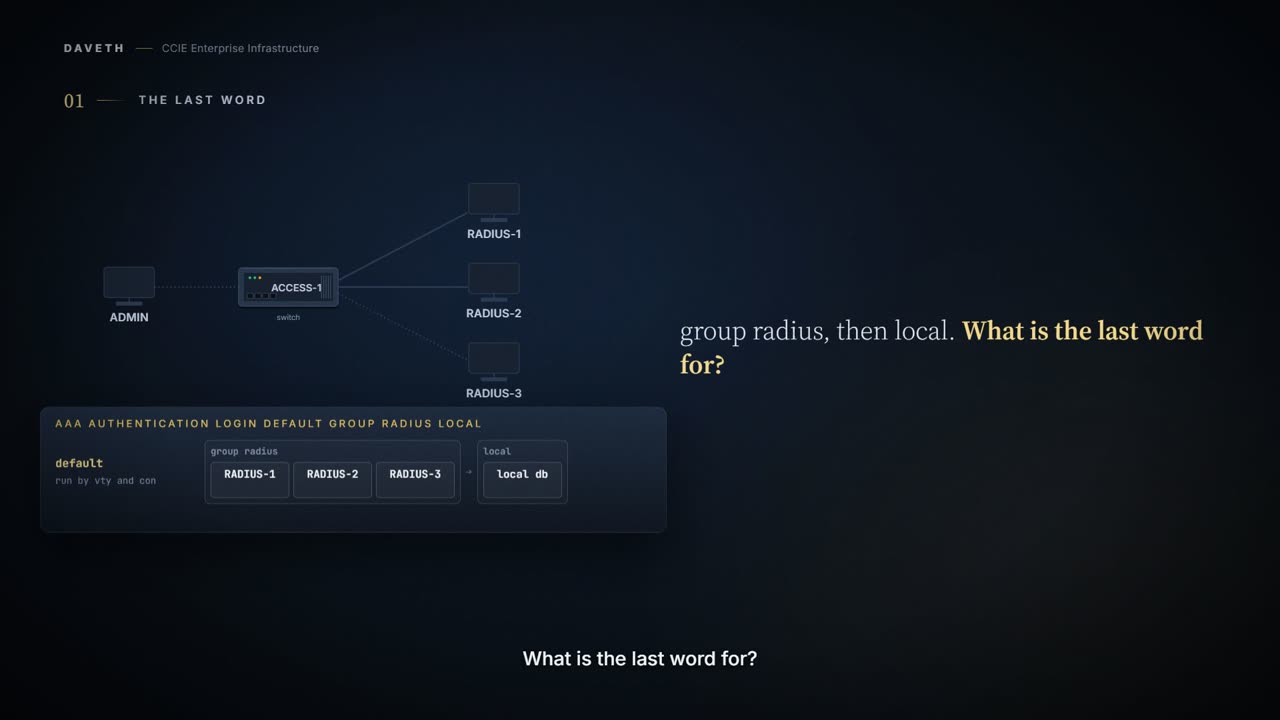
aaa authentication login default group radius local looks like a fallback for when RADIUS turns you down. It is not: the next method is tried only if the previous one fails to respond, not if it rejects the user. The default list applies everywhere a named list does not, so it governs everything you did not configure. Server groups narrow group radius to a subset of servers.
By Arif, founder of Daveth · Updated
The full 6 min walkthrough is in Daveth Pro (Network). See what the plan opens
What this page answers
When does AAA use the next method in a method list?
Only when the previous method fails to respond, returning an error. If a RADIUS server rejects the user, the list stops there and local is never tried. Read it in “A method list”
What does the AAA default method list apply to?
Every line and interface without a named method list explicitly defined. A named list overrides it, so default governs everything you did not configure. Read it in “Turning it on, and which list applies”
What is an AAA server group?
A set of existing RADIUS or TACACS+ servers, defined with aaa group server, used in a method list to send a service to a subset of servers rather than to every configured one. Read it in “Where the methods actually point”
The fallback that is not a fallback
Here is a configuration you have almost certainly seen, and probably written. What is the last word on the second line for?
ACCESS-1# configure terminal
ACCESS-1(config)# aaa new-model
ACCESS-1(config)# aaa authentication login default group radius local
ACCESS-1(config)# end
Most engineers answer: if RADIUS turns me down, fall back to the local database.
That is not what it does, and the gap between what it does and what people think it does is the most useful thing on this page.
Both ways in run that list, because nothing has told either of them otherwise: line vty 0 4 is the network way in and line con 0 is the cable in the front, and default governs both.
This course's reading: which hosts each way in can ever reach
way in    list            hosts it may ask              hosts it will never ask
vty 0 4   default         RADIUS-1, RADIUS-2, RADIUS-3  none
con 0     default         RADIUS-1, RADIUS-2, RADIUS-3  none
Every RADIUS host the device knows about, on both lines. Hold that reading; a server group changes it later, and the line configuration never shows the change.
A method list
A method list is a sequential list describing the authentication methods to be queried in order to authenticate a user.
Queried in order. So far so intuitive:
Cisco IOS XE software uses the first listed method to authenticate users. If that method fails to respond, the Cisco IOS XE software selects the next authentication method listed in the method list.
Read the condition on that second sentence. If that method fails to respond. Not if that method rejects the user.
Now predict, before reading further.
It is important to note that the Cisco IOS XE software attempts authentication with the next listed authentication method only when there is no response from the previous method. If authentication fails at any point in this cycle--meaning that the security server or local username database responds by denying the user access--the authentication process stops and no other authentication methods are attempted.
The chapter has names for the three answers, and the names make the rule hard to misread:
It is important to remember that a FAIL response is significantly different from an ERROR. A FAIL means that the user has not met the criteria contained in the applicable authentication database to be successfully authenticated. Authentication ends with a FAIL response. An ERROR means that the security server has not responded to an authentication query. Only when an ERROR is detected will AAA select the next authentication method defined in the authentication method list.
So: PASS lets the user in, FAIL ends the list, and only ERROR moves on. A method list is a list of places to ask, not a list of second chances.
Why does this catch so many people? Because fallback sounds like if the first one says no, ask the next. A method list stops at the first method that answers, and a rejection is an answer. Silence is the only thing that passes you along.
The same list, walked twice
Every RADIUS server is switched off. Nothing responds.
This course's reading: ada logs in with the servers down
ada at vty 0 4, running default (inherited)
method                answer  why
group radius          ERROR   RADIUS-1, RADIUS-2, RADIUS-3 did not respond
local                 PASS    the local database holds this name

logged in: the walk stopped after 2 methods
The fallback works. Two methods were tried: the first returned ERROR, and the second let her in.
Now the servers come back, and RADIUS-1 rejects ada. Nothing else changed: same list, same local account, same user.
This course's reading: ada logs in with the servers up
ada at vty 0 4, running default (inherited)
method                answer  why
group radius          FAIL    RADIUS-1 rejects this user

refused: the walk stopped after 1 method
One method. local was never consulted. The first server returned FAIL, so the walk ended there, and the account that was going to save the day was never asked about.
The additional methods of authentication are used only if the previous method returns an error, not if it fails.
So what did the usual test prove? An engineer who confirms the local fallback by switching the RADIUS server off has tested one of the two branches, thoroughly. It is the branch that was never going to be a problem, and it will cost them an evening to find that out.
Turning it on, and which list applies
AAA features are not available until you enable AAA globally using the aaa new-model command.
So what does a device with two different login paths look like?
ACCESS-1# configure terminal
ACCESS-1(config)# aaa authentication login CONSOLE-ONLY local
ACCESS-1(config)# end
The default method list is automatically applied to all interfaces except those that have a named method list explicitly defined. A defined method list overrides the default method list.
So default is not merely a name. It is the list that governs everything you did not explicitly configure. A named list does nothing until something references it. How does one come into force?
ACCESS-1# configure terminal
ACCESS-1(config)# line con 0
ACCESS-1(config-line)# login authentication CONSOLE-ONLY
ACCESS-1(config-line)# end
So which list is each line running now? Read the configuration back and look under each line:
This course's drawing of show running-config on ACCESS-1, in the forms these commands take. No command prints this output.
ACCESS-1# show running-config
aaa new-model
! An excerpt, in the forms these commands take. The order a device prints these sections in is not drawn.
!
aaa authentication login default group radius local
aaa authentication login CONSOLE-ONLY local
!
radius server RADIUS-1
 address ipv4 10.1.1.3 auth-port 1645 acct-port 1646
radius server RADIUS-2
 address ipv4 10.1.1.4 auth-port 1645 acct-port 1646
radius server RADIUS-3
 address ipv4 10.1.1.5 auth-port 1645 acct-port 1646
 ! Each server's key line is not drawn.
!
line vty 0 4   ! No list named under this line, so it runs the default.
line con 0
 login authentication CONSOLE-ONLY
! This is the order of every list, which hosts the group holds, and which lines name a list. It does not say whether any server is reachable, and nothing here tells a server that will return FAIL from one that will return ERROR.
Which lines carry a named list, and which inherit the default? On this switch, one line names a list and one inherits default. The inherited one is the one that surprises people, because nothing under it mentions a list at all.
Where the methods actually point
When you write group radius, how many servers is that? The method table gives it as the list of all RADIUS servers: here RADIUS-1, RADIUS-2 and RADIUS-3. A method list can be narrower:
A server group is a way to group existing RADIUS or TACACS+ server hosts for use in method lists. Using server groups, you can specify a subset of the configured server hosts and use them for a particular service.
ACCESS-1# configure terminal
ACCESS-1(config)# radius server RADIUS-1
ACCESS-1(config-radius-server)# address ipv4 10.1.1.3 auth-port 1645 acct-port 1646
ACCESS-1(config-radius-server)# exit
ACCESS-1(config)# aaa group server radius CAMPUS-SERVERS
ACCESS-1(config-sg-radius)# server name RADIUS-1
ACCESS-1(config-sg-radius)# server name RADIUS-2
ACCESS-1(config-sg-radius)# exit
ACCESS-1(config)# aaa authentication login default group CAMPUS-SERVERS local
ACCESS-1(config)# end
The forms are the Catalyst 9300 17.9 RADIUS chapter's: radius server with address ipv4, and aaa group server radius with server name. RADIUS-2 and RADIUS-3 are defined the same way; their lines and every key line are left out here.
This course's reading: which hosts each way in can ever reach
way in    list            hosts it may ask              hosts it will never ask
vty 0 4   default         RADIUS-1, RADIUS-2            RADIUS-3
con 0     CONSOLE-ONLY    none                          RADIUS-1, RADIUS-2, RADIUS-3
A device can have three RADIUS servers configured and a login path that only ever talks to two of them. And the one it never asks is the one that would have said yes to bob:
This course's reading: what each server would say
server      in the group?  reachable  what it would say
RADIUS-1    yes            yes        ada: FAIL, ADA: PASS
RADIUS-2    yes            yes        ada: PASS, ADA: PASS
RADIUS-3    no             yes        ada: PASS, ADA: PASS, bob: PASS
This course's reading: bob logs in over the network
bob at vty 0 4, running default (inherited)
method                answer  why
group CAMPUS-SERVERS  FAIL    RADIUS-1: no account (course's reading)

refused: the walk stopped after 1 method
RADIUS-1 has no account for bob. That this is a FAIL, and not an ERROR, is this course's reading of the chapter's definition: a reachable server that has no account for the user has answered, and the user has not met the criteria. Check it on your own server.
So what happens inside the group when a host says nothing? The same rule, one level down:
(The RADIUS host entries will be tried in the order in which they are configured.) If R1 does not respond, then the network access server processes that as an ERROR and queries R2 for authentication information.
RADIUS-1 stops responding. It is the server that rejected ada.
This course's reading: ada logs in with RADIUS-1 silent
ada at vty 0 4, running default (inherited)
method                answer  why
group CAMPUS-SERVERS  PASS    RADIUS-1 did not respond; RADIUS-2 accepts this user

logged in: the walk stopped after 1 method
She gets in, through RADIUS-2. An outage let in a user the working server refuses. When a login starts working and nobody changed anything, check which server answered.
The menu, and two entries with warning labels
| local | Uses the local username database for authentication. |
| local-case | Uses case-sensitive local username authentication. |
| group radius | Uses the list of all RADIUS servers for authentication. |
| group tacacs+ | Uses the list of all TACACS+ servers for authentication. |
| group group-name | Uses a subset of RADIUS or TACACS+ servers for authentication as defined by the aaa group server radius or aaa group server tacacs+ command. |
| enable | Uses the enable password for authentication. |
| line | Uses the line password for authentication. |
| none | Uses no authentication. |
Two of those deserve a warning label. First:
Because the none keyword enables any user logging in to successfully authenticate, it should be used only as a backup method of authentication.
When is none at the end of a list reached? Only when every earlier method returned ERROR. And when it is reached, it admits everyone. Both halves matter, and people usually remember one.
Second, two keywords that look almost identical. Alongside local there is local-case, which uses case-sensitive local username authentication.
ACCESS-1# configure terminal
ACCESS-1(config)# aaa authentication login CONSOLE-ONLY local-case
ACCESS-1(config)# end
This course's reading: every way in, for every user
user    way in    list            methods tried  outcome
ada     vty 0 4   default (inh)   1              logged in
ada     con 0     CONSOLE-ONLY    1              logged in
ADA     vty 0 4   default (inh)   1              logged in
ADA     con 0     CONSOLE-ONLY    1              refused
bob     vty 0 4   default (inh)   1              refused
bob     con 0     CONSOLE-ONLY    1              refused
The local database holds ada. Somebody typing ADA is refused at the console and logged in over the network, and the second has nothing to do with case.
The console runs local-case and the database holds the other case, so it refuses. The network path never reaches a local method: one method was tried, and RADIUS-2 answered it.
One reading to label. The chapter describes local only as using the local username database for authentication. That local ignores case is this course's reading, from the existence of a case-sensitive variant. Check it on your platform before you rely on it.
A second list for privileged EXEC
Logging in and reaching privileged EXEC are separate lists.
Use the aaa authentication enable default command to create a series of authentication methods that are used to determine whether a user can access the privileged EXEC command level. You can specify up to four authentication methods. The additional methods of authentication are used only if the previous method returns an error, not if it fails.
ACCESS-1# configure terminal
ACCESS-1(config)# aaa authentication enable default group CAMPUS-SERVERS enable
ACCESS-1(config)# end
What does the RADIUS server see as the username? Not the user who logged in. The chapter's note: all aaa authentication enable default requests sent to a RADIUS server carry the username $enab15$, while TACACS+ requests carry the login username. So the RADIUS server is asked about $enab15$, not about the user who logged in.
To specify that the authentication should succeed even if all methods return an error, specify none as the final method in the command line.
One limit worth knowing: The number of AAA method lists that can be configured is 250. The chapter states no per-list method limit for login lists, so this page gives none.
Continue the lesson
The whole lesson, with its drawings and its questions. 7 more sections after the ones above.