
Prompting from the mechanism: document continuation and in-context examples
A model continues the text it is given in the most likely way, so a prompt is not a command to a person but the beginning of a document. Instructions make one kind of continuation more likely, and a few finished examples in the same format make the next answer's format almost certain.
What this page answers
What is the best way to write a prompt?
Write the start of the document you want continued: say the task and format, and add a few finished examples, since continuing a pattern is what models do best. Read it in “A prompt is the start of a document”
Why do examples in a prompt work so well?
Because the model's job is to continue a pattern, a few examples in the same format make the next answer's format almost certain. Read it in the lesson
A prompt is the start of a document
The model's job is to continue the text it's given in the most likely way. So a prompt isn't a command to a person; it's the beginning of a document, and the answer is whatever would most plausibly come next. A bare review, pasted on its own, could plausibly be followed by many things: a reply, another review, a comment. A review preceded by “Classify the sentiment… reply with one word” makes one kind of continuation far more likely. And a few finished examples in the same format make the next answer's format almost certain, because continuing a pattern is the thing these models are best at.
Predict first. Asked to pull the date out of 20 sentences and write it as YYYY-MM-DD, which way of asking gets the most exactly right?
- just the sentence
- clear instructions
- instructions plus three worked examples
Answer. A tie between clear instructions and instructions + 3 examples: just the input 0%, clear instructions 100%, instructions + 3 examples 100%. Asked bare, the model mostly just talked about the sentence, because nothing told it a date in a particular format was wanted.
Three ways to ask, measured
Two tasks I wrote for this lesson: 40 short product reviews, half positive and half negative, some deliberately tricky (“It's fine I guess, but I wouldn't buy it again”); and 20 sentences each containing one date in a different format. Each was asked three ways. How to read the chart: for each task and way of asking, the solid bar is the share answered correctly, and the outlined bar the share answered in exactly the requested format (one word, or a bare date), which is what you'd need to use the answers in a spreadsheet.
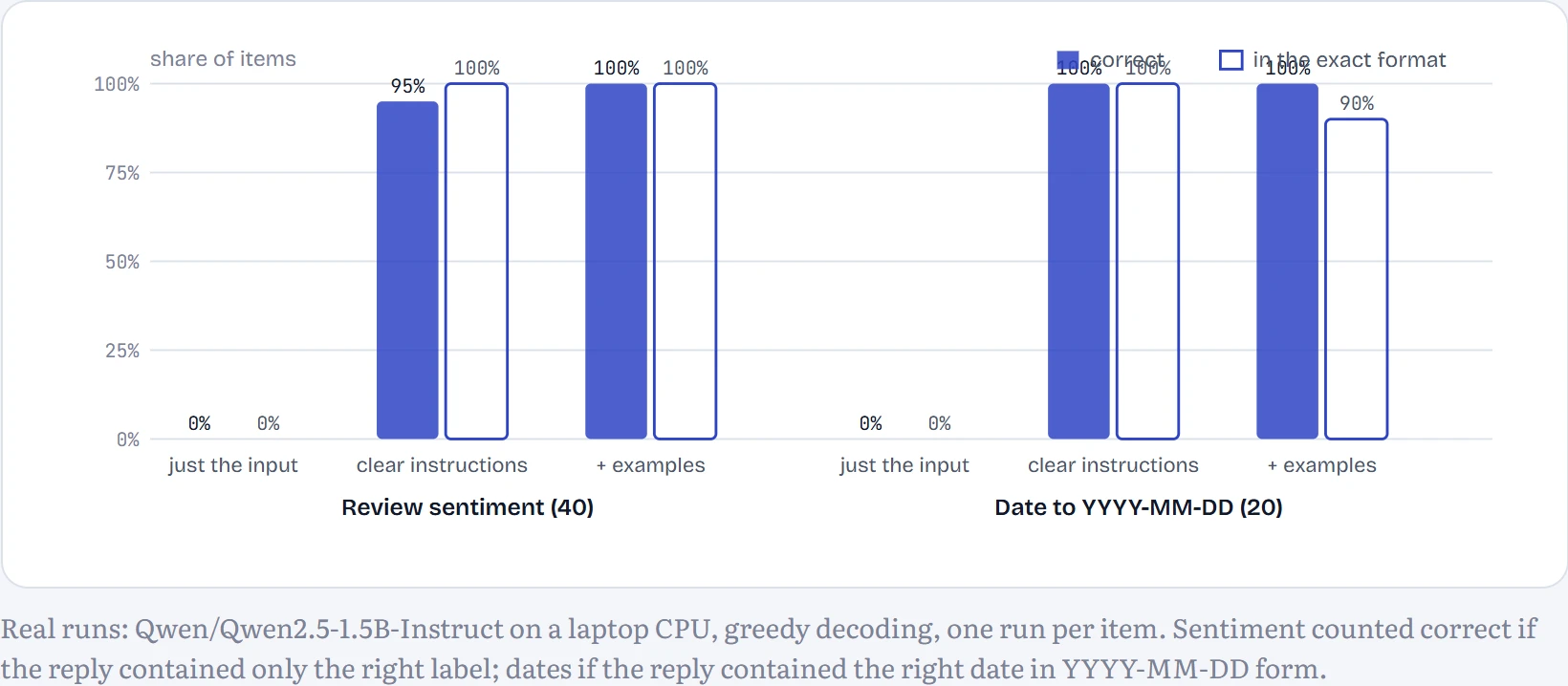
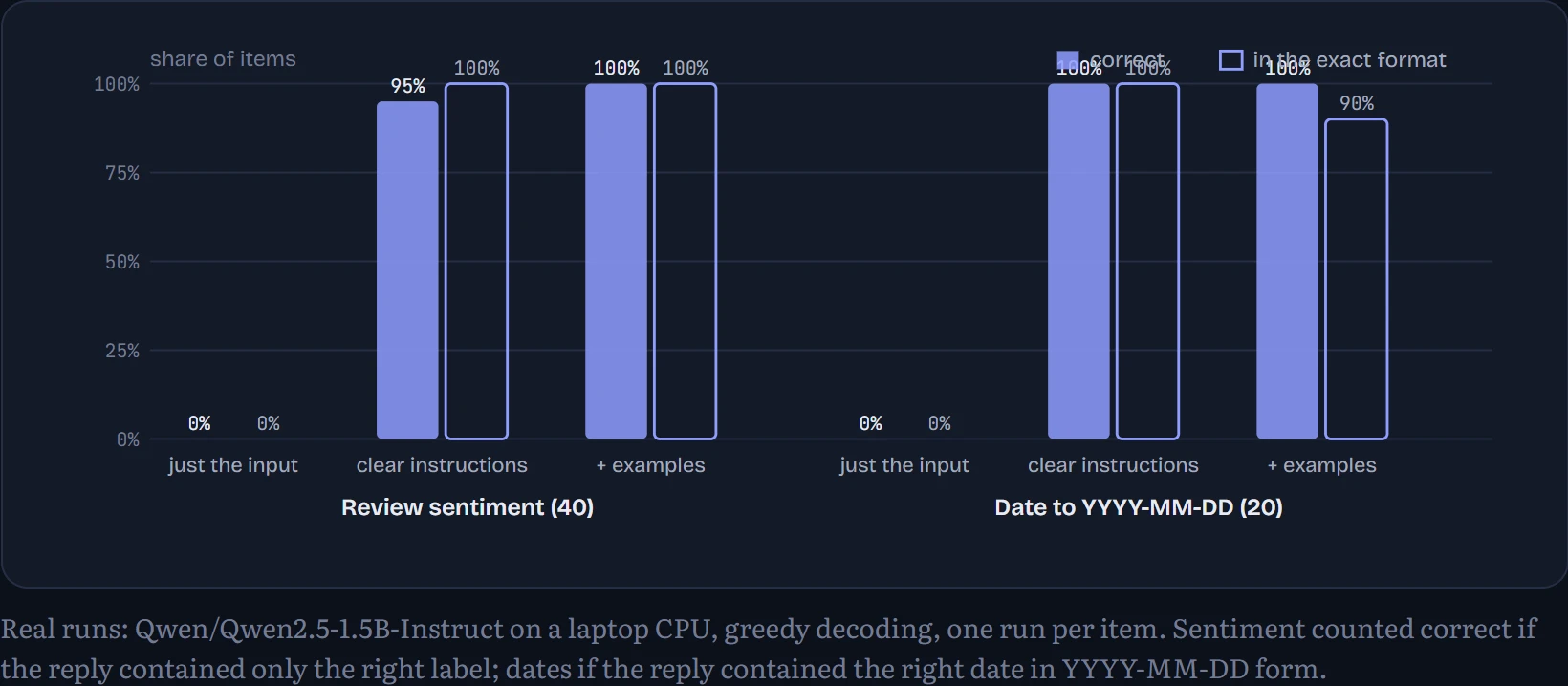
Clear instructions did most of the work on the reviews (0% → 95% correct) and transformed the format (0% → 100% one-word answers). On dates, the jump was 0% → 100% with instructions and 100% with examples. The bare prompts weren't answered wrongly so much as answered as something else: a comment on the review, a sentence about the date. The model did its job, continuing the text plausibly; the prompt just didn't make the wanted answer the plausible one. Here's what the same input got each way:
| Input | just the input | clear instructions | instructions + 3 examples |
|---|---|---|---|
| Absolutely loved it, would buy again. | I'm sorry, but I am not able to understand or respond to that message as it appears to be in another language or dialect. Could you please | positive | positive |
| The meeting moved to March 5th, 2024. | I'm sorry, but I don't have any specific information about the meeting you're referring to or its date of March 5th, 2 | 2024-03-05 | March 2024-03-05 |
Continue the lesson
The whole lesson, with its drawings and its questions. 4 more sections after the ones above.